Replacing a crankshaft position sensor (CKP sensor) is a common repair for vehicles that crank but refuse to start. However, many drivers are surprised when the engine still will not start after installing a new sensor. In some cases, the problem remains exactly the same. In others, the engine may crank longer, run rough, or start intermittently.
The good news is that a new crankshaft sensor does not automatically mean the repair failed. The bad news is that the sensor itself is often only one part of a larger system. Wiring faults, connector issues, timing problems, relearn procedures, and even unrelated fuel or ignition issues can cause a no-start condition after replacing the sensor. Diagnostic experts frequently note that a crankshaft sensor code does not always mean the sensor is the actual problem.
This guide explains why your vehicle may still refuse to start after a crankshaft sensor replacement and how to diagnose the real cause.
Key Takeaways
| Issue | Possible Fix |
|---|---|
| New sensor but engine still won’t start | Check wiring, connectors, and power supply |
| Cranks normally but no start | Verify spark and fuel delivery |
| P0335 code remains | Inspect reluctor wheel and sensor circuit |
| Engine starts then stalls | Perform crankshaft relearn procedure |
| No RPM reading during cranking | Check sensor wiring and ECU communication |
| No spark after replacement | Inspect ignition system and related sensors |
| No fuel injector pulse | Check CKP signal and fuel system operation |
| New aftermarket sensor installed | Replace with OEM-quality sensor |
What Does the Crankshaft Position Sensor Do?
The crankshaft position sensor monitors crankshaft speed and position. The engine control module (ECM) uses this information to determine:
- Ignition timing
- Fuel injection timing
- Engine RPM
- Misfire detection
Without a valid crankshaft signal, many vehicles will not provide spark, fuel injector pulses, or both, resulting in a crank-no-start condition. (THINKCAR)
Why Replacing the Sensor Doesn’t Always Fix the Problem
Many people replace the sensor because they receive a P0335 or related crankshaft sensor code. However, the code often indicates a problem somewhere in the sensor circuit rather than a failed sensor itself. Wiring, connectors, reluctor wheels, battery voltage, and control modules can all trigger similar symptoms.
As a result, installing a new sensor may leave the original problem unresolved.
1. Damaged Wiring Harness
One of the most common causes of continued no-start issues is damaged wiring.
The crankshaft sensor typically operates in a harsh environment near the engine, transmission, or crank pulley. Heat, vibration, oil contamination, and road debris can damage the wiring harness over time.
Symptoms
- Engine cranks but won’t start
- P0335 code returns
- Intermittent starting
- No RPM signal
How to Check
Inspect the wiring for:
- Broken wires
- Melted insulation
- Chafed sections
- Oil contamination
Even a tiny break inside the insulation can interrupt the crankshaft signal. Wiring issues are frequently found when a sensor replacement fails to solve the problem.
Fix
Repair damaged wiring or replace the affected harness section.
2. Faulty Sensor Connector
A connector problem can mimic a bad sensor.
Sometimes the connector becomes loose, corroded, or damaged during sensor replacement. Even if the sensor is new, poor electrical contact prevents signal transmission to the ECM.
Symptoms
- Same symptoms as original failure
- Intermittent no-start
- Check engine light remains on
How to Check
Look for:
- Corrosion
- Bent terminals
- Loose locking tabs
- Pushed-back pins
Fix
Clean or replace the connector as necessary. Connector faults are a common reason new sensors appear not to work. (Car Tech Hub)
3. Defective Replacement Sensor
Not every new sensor is good.
Some aftermarket sensors have poor manufacturing quality and may fail immediately or send an inaccurate signal.
Symptoms
- Vehicle behaves exactly the same
- No RPM signal
- Persistent crankshaft codes
How to Check
Compare the new sensor to the original:
- Connector style
- Mounting dimensions
- Resistance values
- Part number
Fix
Install a high-quality OEM or OEM-equivalent sensor. Many technicians report fewer issues with factory sensors than inexpensive aftermarket alternatives. (AutoCornerd)
4. Incorrect Sensor Installation
The sensor must be positioned correctly relative to the reluctor wheel.
Even slight installation errors can prevent accurate signal generation.
Symptoms
- Crank-no-start condition
- Random stalling
- Engine misfires
Common Installation Errors
- Sensor not fully seated
- Wrong mounting position
- Excessive sensor gap
- Loose mounting bolts
Fix
Remove and reinstall the sensor according to manufacturer specifications.
5. Damaged Reluctor Wheel
The reluctor wheel is the toothed ring that the sensor reads.
If teeth are damaged, bent, cracked, or missing, the ECM cannot interpret crankshaft position correctly.
Symptoms
- Persistent crankshaft codes
- No-start condition
- Random stalling
How to Check
Inspect the reluctor wheel using:
- Borescope
- Visual inspection
- Oscilloscope waveform analysis
Fix
Repair or replace the damaged reluctor wheel. Experts frequently identify reluctor damage as a reason a new sensor fails to solve the problem.
6. Crankshaft Relearn Procedure Not Performed
Many modern vehicles require a crankshaft position relearn after sensor replacement.
The ECM must synchronize with the new sensor’s signal characteristics.
Symptoms
- Engine starts then stalls
- Rough idle
- Check engine light remains on
- Poor acceleration
Fix
Use a compatible scan tool to perform the crankshaft variation relearn procedure when required by the manufacturer.
7. Weak Battery Voltage
Low battery voltage can create false crankshaft sensor symptoms.
A weak battery may crank the engine but not provide enough voltage for the ECM, ignition coils, and fuel injectors to operate correctly.
Symptoms
- Slow cranking
- No-start condition
- Multiple trouble codes
How to Check
Measure battery voltage:
- Engine off: 12.4–12.8 volts
- During cranking: typically above 9.6 volts
Fix
Recharge or replace the battery.
Low battery voltage is often overlooked when diagnosing a no-start condition.
8. Blown Fuse or Missing Sensor Power
The crankshaft sensor may require a dedicated power supply.
A blown fuse can prevent the sensor from functioning even though the sensor itself is new.
A real-world troubleshooting case involved a vehicle that would not start after replacing the sensor. The actual problem was a blown fuse supplying power to the crankshaft sensor circuit. Once the fuse was replaced, the engine started immediately. (Reddit)
Fix
Check:
- ECM fuses
- Ignition fuses
- Sensor power supply
- Ground circuits
9. Camshaft Position Sensor Problems
The crankshaft and camshaft sensors often work together.
Many engines compare signals from both sensors before enabling ignition and fuel injection.
Symptoms
- Crank-no-start
- Cam/crank correlation codes
- Rough running
Fix
Scan for camshaft sensor codes and test the camshaft position sensor circuit. A faulty camshaft sensor can prevent startup even with a new crankshaft sensor.
10. Mechanical Timing Problems
If the timing chain or timing belt has slipped, replacing sensors will not solve the issue.
The ECM may receive crankshaft information, but valve timing may be incorrect.
Symptoms
- Cranking without starting
- Backfiring
- Compression loss
How to Check
Inspect:
- Timing chain alignment
- Timing belt marks
- Camshaft timing
Fix
Repair mechanical timing issues before replacing additional sensors. (Auto Problems)
11. Ignition System Failure
Even with a valid crankshaft signal, the ignition system must produce spark.
Components to Inspect
- Ignition coils
- Coil packs
- Ignition module
- Spark plugs
- Coil wiring
Symptoms
- No spark
- Crank-no-start
- Misfires before failure
Fix
Perform spark testing at the coils and plugs.
12. Fuel System Problems
The sensor may not be the cause at all.
A failing fuel pump, clogged filter, or faulty injector circuit can create identical symptoms.
Symptoms
- Cranks normally
- No fuel pressure
- No injector pulse
Fix
Check:
- Fuel pressure
- Fuel pump operation
- Injector signals
- Fuel pump relay
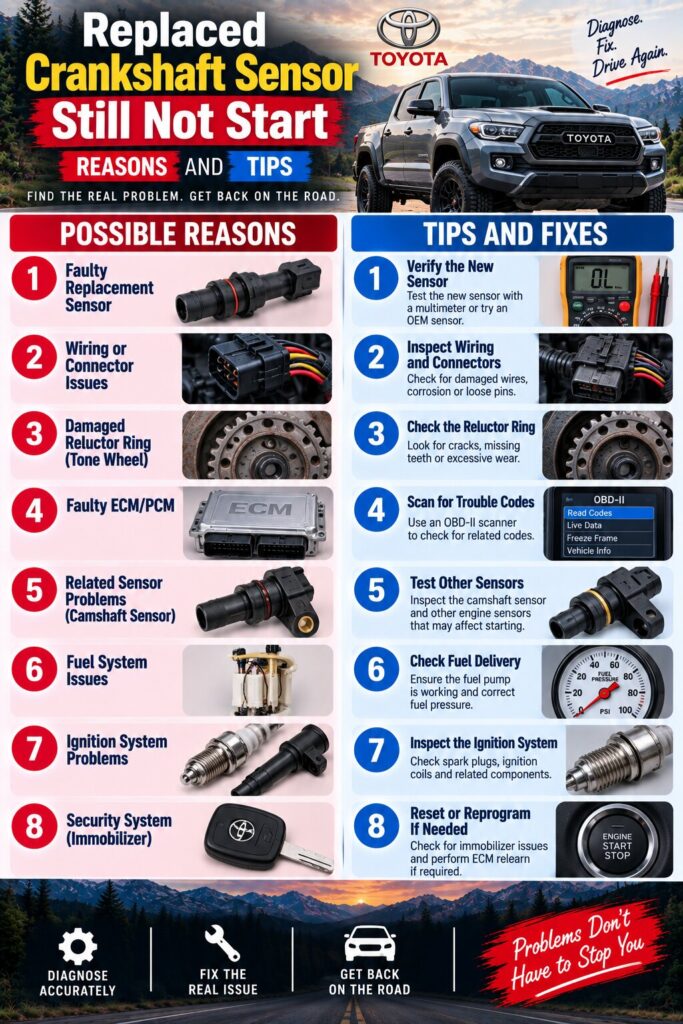
How to Diagnose a No-Start After Sensor Replacement
Step 1: Check for RPM During Cranking
Connect a scan tool and observe engine RPM.
If RPM remains at zero, the ECM likely is not receiving a valid crankshaft signal.
Step 2: Verify Sensor Power and Ground
Use a multimeter to confirm:
- Power supply
- Ground circuit
- Signal continuity
Step 3: Scan for Trouble Codes
Common codes include:
- P0335
- P0336
- P0340
- P0341
These codes can point toward circuit or synchronization issues.
Step 4: Test for Spark
Use a spark tester during cranking.
Step 5: Check Fuel Pressure
Verify fuel reaches the engine at the proper pressure.
Step 6: Inspect Mechanical Timing
Check timing marks if all electrical tests pass.
Troubleshooting Table
| Symptom | Most Likely Cause | Solution |
|---|---|---|
| No RPM reading | Wiring or connector fault | Repair circuit |
| Cranks but won’t start | No spark or fuel | Test ignition and fuel systems |
| P0335 remains | Circuit or reluctor problem | Inspect sensor circuit |
| Starts then stalls | Relearn required | Perform relearn procedure |
| Intermittent no-start | Loose connection | Repair connector |
| No spark | Ignition fault | Test coils and modules |
| No injector pulse | ECM not receiving signal | Diagnose CKP circuit |
| New sensor failed immediately | Defective part | Install OEM sensor |
Frequently Asked Questions
Can a new crankshaft sensor be bad?
Yes. Defective replacement sensors, especially low-quality aftermarket units, can fail immediately or provide inaccurate signals.
Why does my car crank but not start after replacing the sensor?
The problem may involve wiring, connectors, ignition components, fuel delivery,
Does a crankshaft sensor require programming?
Some vehicles require a crankshaft variation relearn after replacement, while others do not.
Can a bad camshaft sensor cause the same symptoms?
Yes. Many engines need valid signals from both crankshaft and camshaft sensors before they will start.
Can low battery voltage prevent starting after sensor replacement?
Yes. Low voltage can affect the ECM, ignition system, and sensor operation.
Should I replace the sensor again?
Not until you verify wiring, connectors, power supply, and diagnostic data. Replacing additional sensors without testing often wastes time and money.
Final Thoughts
If you replaced the crankshaft position sensor and the engine still will not start, the sensor may not be the real problem. Wiring faults, damaged connectors, blown fuses, weak batteries, ignition failures, fuel delivery issues, timing problems, and relearn procedures are all common causes of continued no-start conditions. The most effective approach is systematic diagnosis rather than replacing more parts. By checking RPM data, sensor power, spark, fuel pressure, and mechanical timing, you can identify the actual fault and get the vehicle running again.