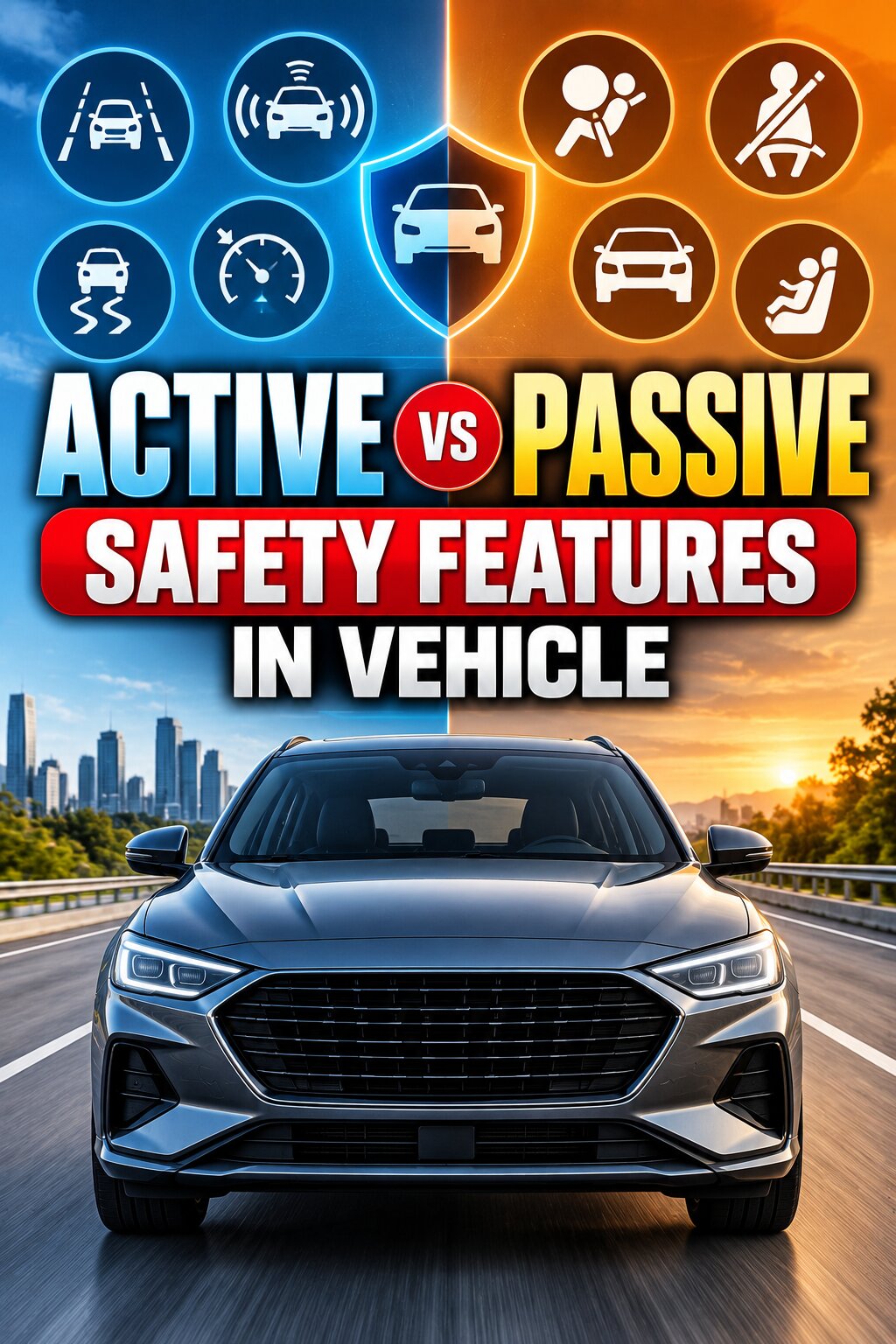
Vehicle safety has evolved dramatically over the past few decades. Modern cars are equipped with advanced technologies designed not only to protect occupants during a crash but also to help prevent accidents from happening in the first place. These technologies are generally divided into two categories: active safety features and passive safety features.
Understanding the difference between active and passive safety systems is important whether you are shopping for a new vehicle, comparing safety ratings, or simply trying to become a more informed driver. While active safety features focus on accident prevention, passive safety features focus on injury reduction when a collision occurs. Together, they form a comprehensive safety strategy that significantly improves road safety. (IEEE Technology Navigator)
This guide explains how active and passive safety features work, their benefits, examples, limitations, and why modern vehicles need both systems.
Key Takeaways
| Feature Type | Purpose | Examples |
|---|---|---|
| Active Safety | Prevent accidents from occurring | ABS, ESC, AEB, Lane Keep Assist |
| Passive Safety | Reduce injuries during a crash | Airbags, Seat Belts, Crumple Zones |
| When It Works | Before a collision | During and after a collision |
| Main Goal | Crash avoidance | Occupant protection |
| Driver Involvement | Often assists driver actions | Usually activates automatically |
| Importance | Reduces accident risk | Minimizes injury severity |
What Are Active Safety Features?
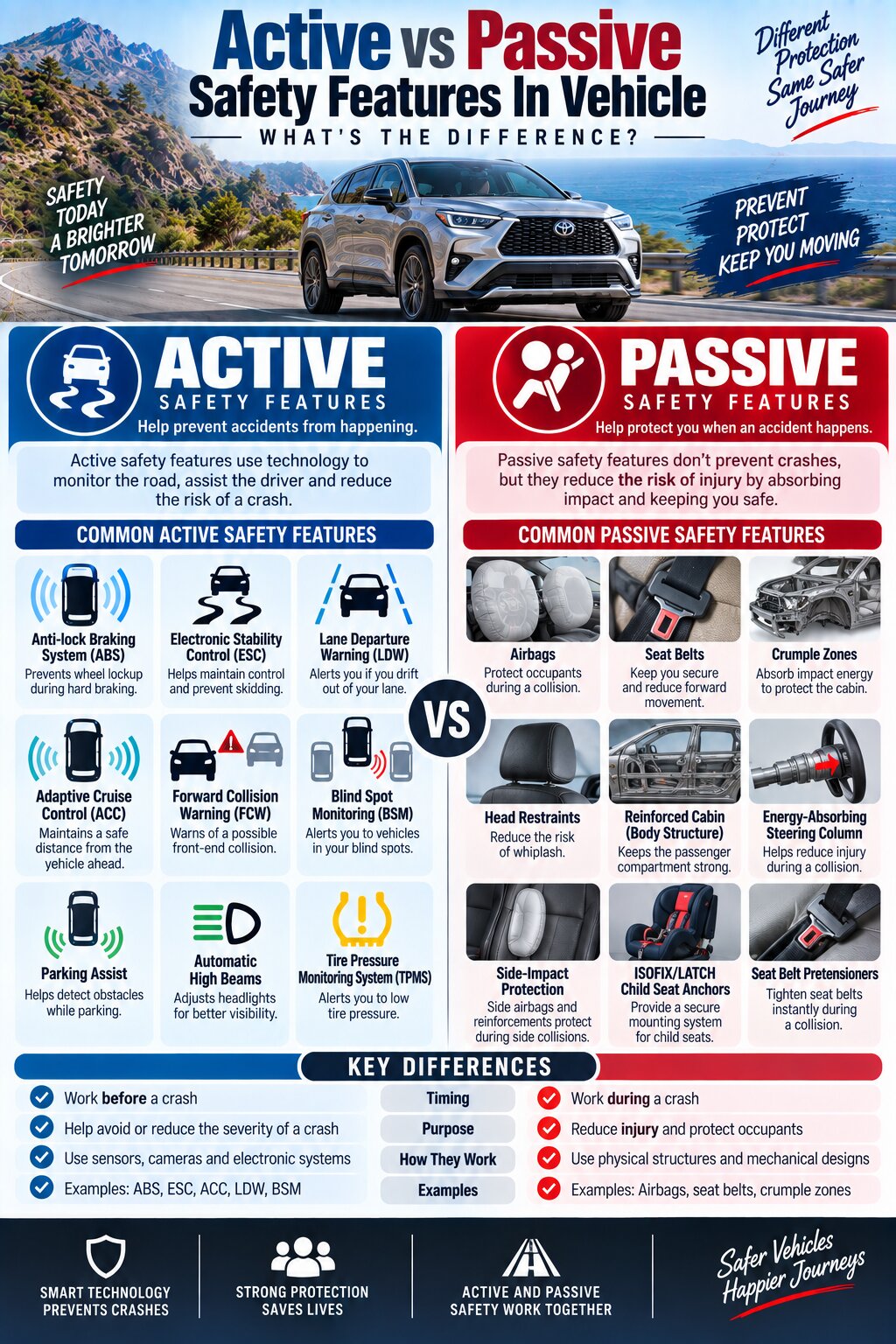
Active safety features are systems designed to help drivers avoid accidents. These technologies continuously monitor vehicle behavior, road conditions, and surrounding traffic. When necessary, they warn the driver or automatically intervene to help prevent a collision. (NHTSA)
In simple terms, active safety systems work before an accident happens.
These systems have become increasingly sophisticated thanks to advancements in sensors, cameras, radar, and vehicle software.
How Active Safety Systems Work
Active safety technologies constantly collect information from:
- Cameras
- Radar sensors
- Ultrasonic sensors
- Steering sensors
- Wheel-speed sensors
- Brake sensors
The vehicle’s computer analyzes this data in real time and can respond faster than a human driver in certain situations.
Main Objectives of Active Safety
Active safety systems aim to:
- Prevent collisions
- Improve vehicle stability
- Maintain driver control
- Reduce human error
- Enhance visibility
- Warn drivers of hazards
Since human error contributes to most road accidents, active safety systems help reduce risks associated with distraction, fatigue, poor judgment, and delayed reaction times. (Arrive Alive)
Common Active Safety Features
Anti-Lock Braking System (ABS)
ABS prevents wheels from locking during hard braking.
Without ABS, wheels can lock and cause a vehicle to skid uncontrollably. ABS rapidly pulses brake pressure, allowing drivers to maintain steering control while braking. (Maruti Suzuki)
Electronic Stability Control (ESC)
ESC helps drivers maintain control during sudden maneuvers.
The system monitors steering input and vehicle movement. If the vehicle begins to skid or slide, ESC selectively applies brakes to individual wheels to restore stability. (IEEE Technology Navigator)
Traction Control System (TCS)
Traction control prevents excessive wheel spin.
This feature is particularly useful on:
- Wet roads
- Snow-covered roads
- Gravel surfaces
- Muddy terrain
It improves vehicle grip and stability.
Automatic Emergency Braking (AEB)
AEB detects potential collisions and automatically applies the brakes if the driver fails to react in time.
Many modern vehicles can detect:
- Vehicles
- Pedestrians
- Cyclists
This technology can reduce collision severity or avoid accidents entirely.
Forward Collision Warning
Forward collision warning alerts drivers when they approach another vehicle too quickly.
The system typically provides:
- Audible warnings
- Visual alerts
- Steering wheel vibrations
These warnings help drivers react sooner.
Lane Departure Warning
This system alerts drivers when they unintentionally drift from their lane.
It is particularly useful during:
- Long highway trips
- Fatigue-related driving
- Distracted driving situations
Lane Keeping Assist
Lane keeping assist goes beyond warnings.
Instead of merely alerting the driver, the system can provide steering corrections to help keep the vehicle centered in its lane.
Blind Spot Monitoring
Blind spot monitoring warns drivers when another vehicle occupies a hard-to-see area beside the car.
Many systems use:
- Side-mounted radar
- Visual indicators
- Audible alerts
This reduces lane-change accidents.
Adaptive Cruise Control
Adaptive cruise control automatically adjusts vehicle speed to maintain a safe following distance.
Unlike traditional cruise control, it can:
- Slow down
- Accelerate
- Maintain traffic flow
This feature improves convenience and safety during highway driving.
Benefits of Active Safety Features
Accident Prevention
The biggest advantage is collision prevention.
Avoiding a crash is always better than surviving one. Active safety systems significantly reduce accident risk by assisting drivers before dangerous situations escalate.
Faster Reaction Times
Electronic systems react within milliseconds.
This speed can make the difference between a near miss and a serious accident.
Better Vehicle Control
Technologies such as ESC and ABS improve handling during emergencies.
Drivers maintain greater control during:
- Sudden braking
- Sharp turns
- Slippery conditions
Reduced Driver Fatigue
Features like adaptive cruise control and lane centering reduce workload during long trips.
Improved Safety for Everyone
Active systems protect:
- Drivers
- Passengers
- Pedestrians
- Cyclists
- Other road users
What Are Passive Safety Features?
Passive safety features are designed to protect occupants when a collision becomes unavoidable.
Unlike active safety systems, passive safety technologies do not prevent crashes. Instead, they minimize injuries during and after an impact.
These systems work during or after a collision.
How Passive Safety Systems Work
Passive safety systems manage crash energy and occupant movement.
They accomplish this by:
- Absorbing impact forces
- Preventing occupant ejection
- Cushioning occupants
- Protecting the passenger compartment
The goal is simple: reduce injury severity.
Common Passive Safety Features
Seat Belts
Seat belts remain the most important passive safety feature in any vehicle.
Their primary functions include:
- Preventing ejection
- Reducing occupant movement
- Distributing crash forces
- Positioning occupants for airbag protection
Decades of crash data confirm that seat belts dramatically reduce fatalities and serious injuries.
Airbags
Airbags deploy during collisions to cushion occupants.
Modern vehicles may include:
- Front airbags
- Side airbags
- Curtain airbags
- Knee airbags
- Center airbags
Airbags work alongside seat belts rather than replacing them. (Wikipedia)
Crumple Zones
Crumple zones are specially engineered sections of the vehicle structure.
They deform during a collision to absorb crash energy and reduce forces transferred to occupants.
Reinforced Passenger Cell
The passenger compartment is designed to remain intact during severe impacts.
High-strength steel and advanced structural engineering help protect occupants from intrusion.
Head Restraints
Head restraints reduce neck injuries during rear-end collisions.
They help prevent whiplash by supporting the head during sudden impacts.
Side Impact Protection
Many vehicles include reinforced side structures that improve occupant protection during side collisions.
Laminated Windshields
Laminated glass helps prevent occupants from being ejected and reduces injuries caused by shattered glass. (ScienceABC)
Benefits of Passive Safety Features
Injury Reduction
Passive systems significantly reduce:
- Head injuries
- Chest injuries
- Neck injuries
- Spinal injuries
Occupant Protection
They provide critical protection when accidents cannot be avoided.
Improved Crash Survival
Modern passive safety engineering has dramatically improved survival rates in serious collisions.
Protection for Multiple Occupants
Most passive systems protect:
- Drivers
- Front passengers
- Rear passengers
- Children
Active Safety vs Passive Safety: Key Differences
Purpose
Active safety prevents accidents.
Passive safety reduces injuries after accidents occur.
Timing
Active safety works before a crash.
Passive safety works during and after a crash.
Technology
Active safety relies heavily on:
- Sensors
- Cameras
- Software
- Electronic controls
Passive safety relies on:
- Structural design
- Restraint systems
- Energy absorption materials
Driver Interaction
Many active systems assist or warn drivers.
Most passive systems activate automatically during impact.
Comparison Table
| Category | Active Safety | Passive Safety |
|---|---|---|
| Goal | Prevent accidents | Reduce injuries |
| Timing | Before collision | During collision |
| Uses Sensors | Yes | Usually no |
| Requires Monitoring | Continuous | Event-triggered |
| Examples | ABS, ESC, AEB | Airbags, Seat Belts |
| Driver Assistance | High | Minimal |
| Injury Protection | Indirect | Direct |
| Crash Avoidance | Yes | No |
Why Modern Vehicles Need Both
Some drivers mistakenly believe active safety systems make passive safety less important.
That is not true.
Even the most advanced active safety systems cannot prevent every accident. Weather, road conditions, mechanical failures, and unpredictable human behavior can still lead to collisions.
Likewise, passive safety alone cannot prevent accidents.
The safest vehicles combine both approaches:
- Prevent accidents whenever possible.
- Protect occupants if prevention fails.
This layered strategy produces the highest level of overall safety.
Emerging Safety Technologies
Vehicle safety continues to evolve rapidly.
New active safety technologies include:
- Driver monitoring systems
- Traffic jam assist
- Highway driving assist
- Intersection collision avoidance
- Pedestrian detection
- Cyclist detection
At the same time, passive safety systems continue improving through:
- Advanced airbag designs
- Smarter seatbelt pretensioners
- Improved crash structures
- Enhanced side-impact protection
Manufacturers increasingly integrate active and passive systems to work together. For example, crash prediction sensors may tighten seat belts before an impact occurs. (Automotive Safety Council)
Which Is More Important?
The answer is both.
Active safety helps avoid accidents.
Passive safety helps people survive accidents.
Without active safety, crash frequency increases.
Without passive safety, injury severity increases.
The best vehicles excel in both categories. Modern crash-test organizations and safety agencies evaluate both active and passive safety performance when determining overall vehicle safety ratings.
Frequently Asked Questions
What is the difference between active and passive safety features?
Active safety features help prevent accidents, while passive safety features protect occupants during a collision.
Is ABS an active safety feature?
Yes. ABS helps drivers maintain steering control during emergency braking situations.
Are airbags active or passive safety features?
Airbags are considered passive safety features because they protect occupants during a crash.
Is electronic stability control an active safety system?
Yes. ESC helps prevent skidding and loss of vehicle control.
Why are seat belts considered passive safety devices?
Seat belts primarily reduce injuries during a collision by restraining occupants.
Can active safety features completely prevent accidents?
No. They reduce risk significantly but cannot eliminate all accidents. Driver attention remains essential.
Which safety feature saves the most lives?
Seat belts remain one of the most effective vehicle safety devices ever developed.
Do modern cars use both active and passive safety systems?
Yes. Nearly every modern vehicle combines both types to maximize overall safety.
Final Thoughts
Active and passive safety features serve different but equally important purposes. Active safety systems such as ABS, ESC, lane-keeping assist, and automatic emergency braking work continuously to help drivers avoid accidents. Passive safety systems such as seat belts, airbags, crumple zones, and reinforced cabins step in when a collision cannot be avoided.
The safest vehicles on the road today combine advanced active safety technologies with strong passive protection. Together, they create multiple layers of defense that reduce crash risk, minimize injuries, and save lives. When evaluating a vehicle, consider both categories rather than focusing on a single feature. A balanced approach to safety provides the greatest protection for drivers, passengers, and everyone sharing the road.