Spark plugs are among the smallest components in an engine, yet they play a critical role in performance, fuel economy, emissions, and starting reliability. Every gasoline engine relies on spark plugs to ignite the air-fuel mixture inside the combustion chamber.
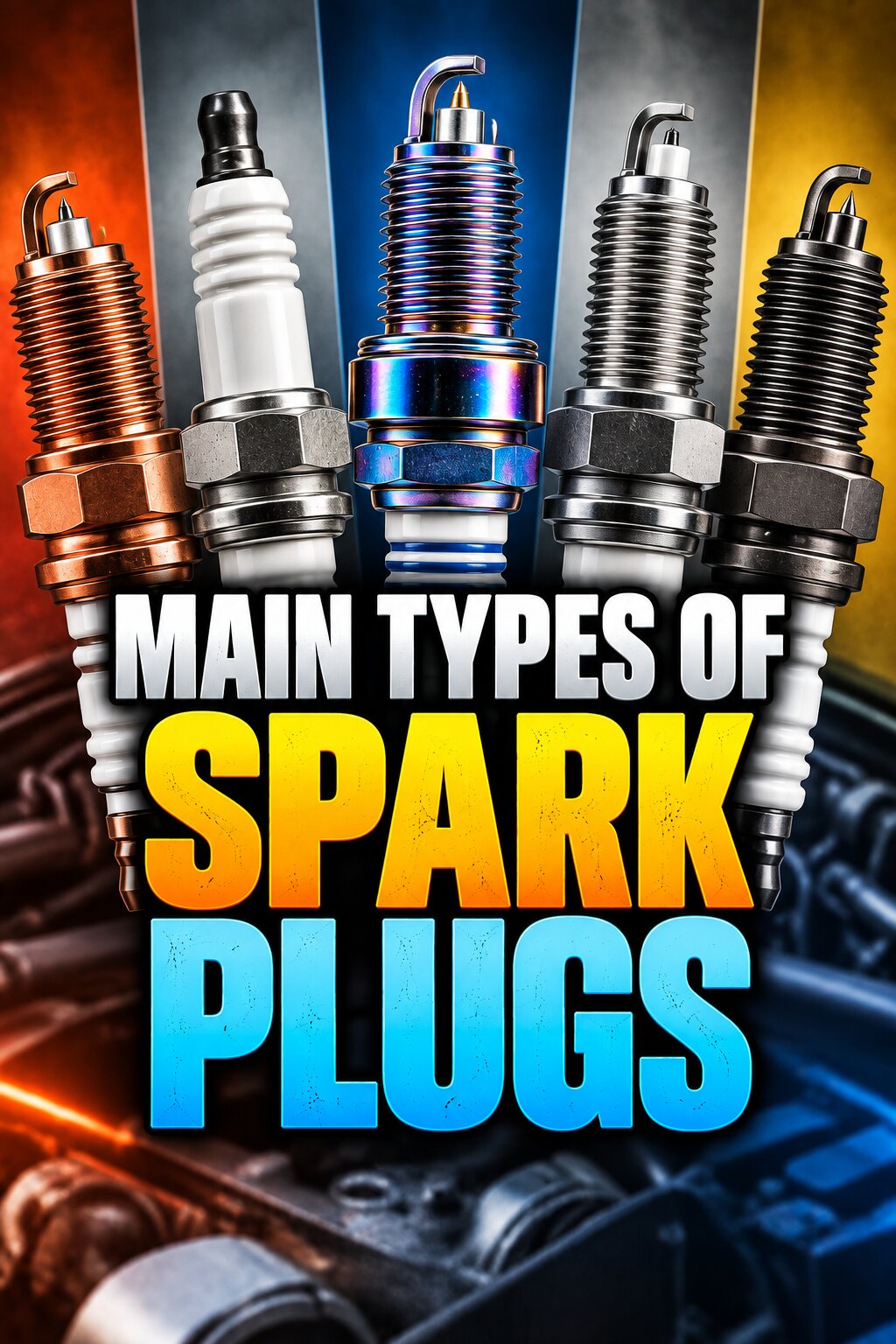
Modern spark plugs come in several designs and materials, including copper, platinum, iridium, ruthenium, silver, and multi-electrode variants. Each type offers different advantages in terms of lifespan, performance, durability, and cost. Choosing the correct spark plug is essential because using the wrong type can lead to poor fuel economy, engine misfires, rough idling, and increased maintenance costs.
This guide explains the major types of spark plugs, their advantages and disadvantages, and how to select the right one for your vehicle.
What Is a Spark Plug?
A spark plug is an ignition device that delivers an electrical spark into the combustion chamber of a gasoline engine.
When high voltage travels from the ignition coil to the spark plug, an electrical arc forms between the center and ground electrodes. This spark ignites the compressed air-fuel mixture, creating combustion that powers the engine. (Wikipedia)
Although all spark plugs perform the same basic function, their materials and construction vary significantly.
How Spark Plugs Are Classified
Spark plugs are typically classified by:
Electrode Material
The most common classification method includes:
- Copper
- Platinum
- Double Platinum
- Iridium
- Double Iridium
- Ruthenium
- Silver
Heat Range
Spark plugs can be:
- Hot spark plugs
- Cold spark plugs
Electrode Design
Examples include:
- Single electrode
- Multi-electrode
- Fine-wire electrode
- Surface-gap electrode
Each design serves specific engine requirements.
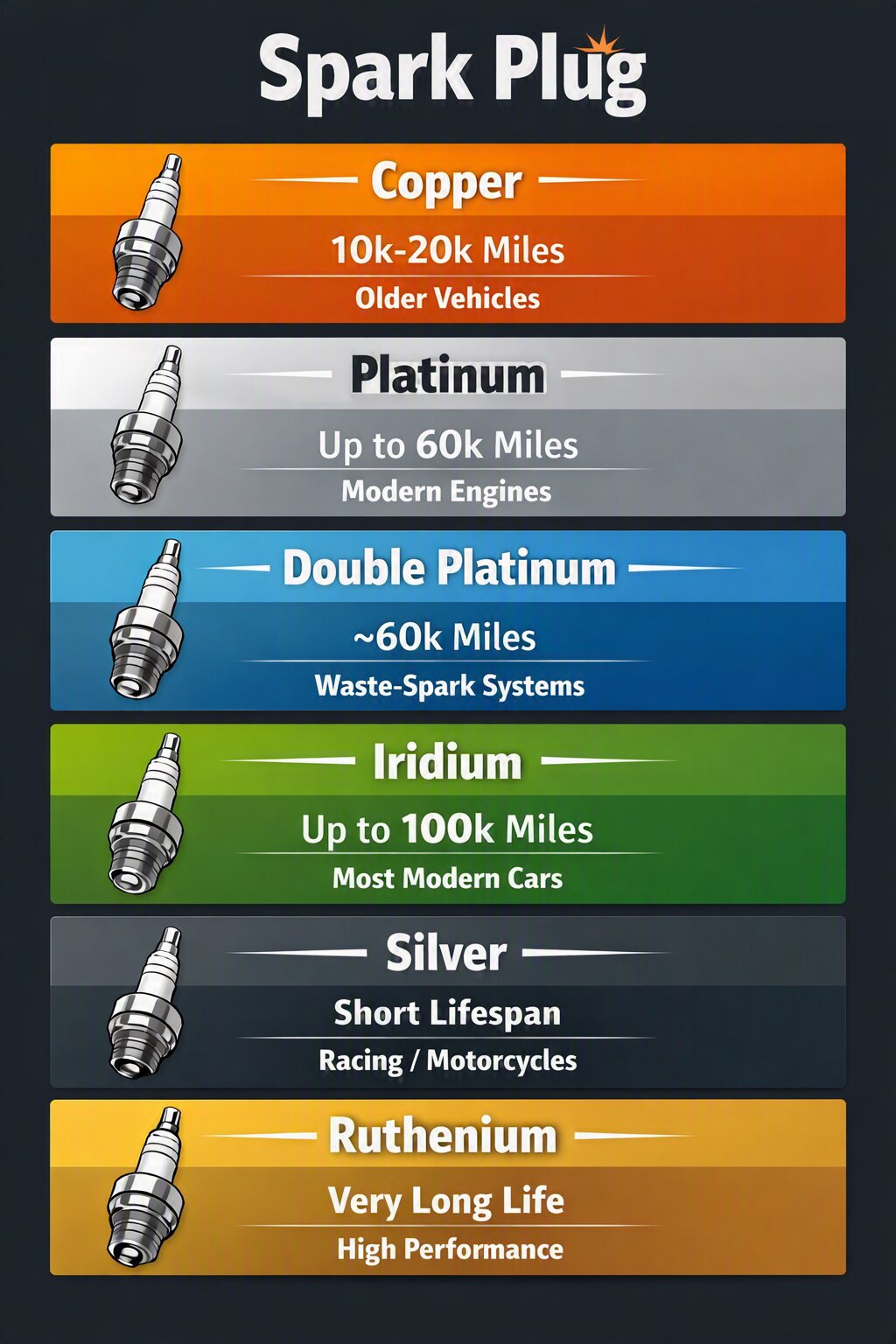
Copper Spark Plugs
Copper spark plugs are the oldest and most traditional spark plug design.
Despite their name, the firing tip is usually a nickel alloy while the core contains copper for heat transfer and conductivity. Copper plugs remain common in older vehicles and some performance applications. (SparkPlugs)
Advantages
- Excellent electrical conductivity
- Affordable
- Strong spark output
- Suitable for older engines
- Good performance in modified engines
Disadvantages
- Short lifespan
- Faster electrode wear
- More frequent replacement intervals
Typical Lifespan
Most copper plugs last:
- 20,000–30,000 miles
- 30,000–50,000 km
depending on engine conditions.
Best Applications
- Older vehicles
- Classic cars
- High-performance applications requiring frequent maintenance
- Engines specifically designed for copper plugs
Platinum Spark Plugs
Platinum spark plugs were introduced to provide longer service life than traditional copper plugs.
A platinum disc is welded onto the center electrode, improving wear resistance and durability. Platinum plugs became widely used as manufacturers extended maintenance intervals.
Advantages
- Longer lifespan than copper
- Improved resistance to wear
- Better fuel economy over time
- Reduced maintenance
Disadvantages
- More expensive than copper
- Slightly less conductive
Typical Lifespan
Platinum plugs generally last:
- 60,000–80,000 miles
- 100,000 km or more in some applications
Best Applications
- Daily-driven vehicles
- Commuter cars
- Factory-equipped platinum applications
Double Platinum Spark Plugs
Double platinum plugs feature platinum on both the center and ground electrodes.
These plugs were developed primarily for waste-spark ignition systems where spark direction alternates between electrodes. Without platinum on both sides, wear can occur much faster.
Advantages
- Excellent durability
- Improved wear resistance
- Suitable for waste-spark systems
- Longer replacement intervals
Disadvantages
- Higher cost than standard platinum
- Not always necessary for every engine
Typical Lifespan
Most double platinum plugs last:
- 80,000–100,000 miles
Best Applications
- Waste-spark ignition systems
- Mid-2000s gasoline vehicles
- Long-service interval engines
Iridium Spark Plugs
Iridium spark plugs are currently among the most popular premium spark plug options.
Iridium is significantly harder and more heat-resistant than platinum, allowing manufacturers to use an extremely fine center electrode. The fine-wire design requires less voltage to generate a spark and maintains performance over a longer period.
Advantages
- Long service life
- Improved ignitability
- Better cold starting
- Excellent durability
- Consistent performance
Disadvantages
- Higher cost
- Not always necessary for older engines
Typical Lifespan
Iridium plugs often last:
- 80,000–120,000 miles
- 100,000+ miles in many applications
Best Applications
- Modern vehicles
- Turbocharged engines
- Direct-injection engines
- High-compression engines
Double Iridium Spark Plugs
Double iridium spark plugs use iridium on both the center and ground electrodes.
This design maximizes durability while maintaining excellent spark quality throughout the plug’s service life.
Advantages
- Extremely long lifespan
- Superior ignition performance
- Excellent wear resistance
- Consistent spark quality
Disadvantages
- Most expensive common spark plug type
Typical Lifespan
Many double iridium plugs exceed:
- 100,000 miles
Best Applications
- Modern premium vehicles
- Long-service interval vehicles
- Turbocharged engines
Ruthenium Spark Plugs
Ruthenium spark plugs represent one of the newest developments in spark plug technology.
Ruthenium belongs to the platinum-group metals and offers exceptional durability and heat resistance. Manufacturers increasingly use ruthenium in modern direct-injection and turbocharged engines.
Advantages
- Exceptional longevity
- Strong spark performance
- Excellent heat resistance
- Suitable for modern engine designs
Disadvantages
- Higher initial cost
- Limited availability compared with iridium
Typical Lifespan
Many ruthenium plugs are rated for:
- 100,000–120,000+ miles
Best Applications
- Turbocharged engines
- Direct-injection engines
- Long-term ownership
Silver Spark Plugs
Silver spark plugs are less common but are still used in certain applications.
Silver offers excellent thermal conductivity and electrical conductivity.
Advantages
- Excellent conductivity
- Efficient heat transfer
- Good performance
Disadvantages
- Shorter lifespan than iridium or platinum
- Less commonly available
Best Applications
- Certain European vehicles
- Specialty performance applications
Multi-Electrode Spark Plugs
Some spark plugs feature multiple ground electrodes.
These may include:
- Two-electrode plugs
- Three-electrode plugs
- Four-electrode plugs
Contrary to popular belief, multiple electrodes do not create multiple sparks simultaneously. Instead, they help distribute wear and extend service life. (DENSO)
Advantages
- Longer lifespan
- Reduced electrode wear
- Improved durability
Disadvantages
- Higher cost
- Limited performance gains
Hot Spark Plugs
Hot spark plugs retain more heat in the firing tip.
Characteristics
- Higher operating temperature
- Better resistance to carbon fouling
- Suitable for low-speed engines
Common Applications
- Older vehicles
- Light-duty driving
- Lower-performance engines
Cold Spark Plugs
Cold spark plugs transfer heat away from the combustion chamber more rapidly.
Characteristics
- Cooler operation
- Reduced risk of pre-ignition
- Better for high-performance engines
Common Applications
- Turbocharged engines
- Racing engines
- High-compression applications
Spark Plug Types Comparison Table
| Spark Plug Type | Lifespan | Cost | Performance | Best For |
|---|---|---|---|---|
| Copper | 20k–30k miles | Low | Excellent conductivity | Older vehicles |
| Platinum | 60k–80k miles | Medium | Good | Daily drivers |
| Double Platinum | 80k–100k miles | Medium-High | Very good | Waste-spark systems |
| Iridium | 80k–120k miles | High | Excellent | Modern engines |
| Double Iridium | 100k+ miles | Highest | Excellent | Premium vehicles |
| Ruthenium | 100k–120k+ miles | High | Excellent | Turbo and DI engines |
| Silver | Moderate | Medium | Excellent conductivity | Specialty applications |
Which Spark Plug Type Is Best?
The answer depends on your vehicle.
For Older Vehicles
Copper plugs are often ideal because many older ignition systems were designed around them.
For Daily Drivers
Platinum plugs provide an excellent balance of cost and longevity.
For Modern Vehicles
Iridium plugs are often the factory recommendation and provide excellent durability.
For Turbocharged Engines
Iridium and ruthenium plugs generally perform best under high heat and pressure conditions.
For Waste-Spark Ignition Systems
Double platinum plugs are usually recommended.
Signs Your Spark Plugs Need Replacement
Regardless of plug type, replacement may be necessary if you notice:
- Engine misfires
- Rough idle
- Poor fuel economy
- Hard starting
- Reduced acceleration
- Check Engine Light
- Increased emissions
These symptoms often indicate worn or fouled spark plugs.
Common Spark Plug Brands
Popular spark plug manufacturers include:
- NGK
- Denso
- Bosch
- Champion
- Motorcraft
- ACDelco
- Autolite
Most automakers specify one or more of these brands as OEM suppliers.
Frequently Asked Questions
What is the most common spark plug type?
Iridium spark plugs are among the most common factory-installed spark plugs in modern vehicles because of their long lifespan and durability.
Are iridium spark plugs better than platinum?
Iridium plugs generally last longer and allow a finer electrode design, but the best choice is always the plug specified by the vehicle manufacturer.
Can I replace copper plugs with iridium plugs?
In many cases yes, but you should verify compatibility and follow manufacturer recommendations.
What spark plugs last the longest?
Ruthenium, double iridium, and premium iridium spark plugs typically provide the longest service life.
Do multiple electrodes increase horsepower?
Generally no. Multi-electrode plugs mainly improve durability and service life rather than power output.
How often should spark plugs be replaced?
Replacement intervals vary by type:
- Copper: 20,000–30,000 miles
- Platinum: 60,000–80,000 miles
- Iridium: 80,000–120,000 miles
Always follow the manufacturer’s maintenance schedule.
Final Thoughts
Spark plugs may be small, but they have a major impact on engine performance, fuel economy, emissions, and reliability. Copper plugs remain a cost-effective option for older vehicles, while platinum plugs provide longer service life for everyday driving.
Iridium and double iridium plugs dominate modern engines because of their durability and ignition efficiency, while ruthenium plugs represent the latest advancement in spark plug technology. Understanding the different types of spark plugs and selecting the correct one for your engine can improve performance, reduce maintenance costs, and help keep your vehicle running smoothly for years.