Cruise control is one of the most convenient features on modern Chevrolet vehicles. Whether you drive a Silverado, Equinox, Tahoe, Malibu, Traverse, or Colorado, cruise control helps reduce driver fatigue and improve fuel efficiency on long highway trips.
However, Chevy owners occasionally experience issues such as cruise control not engaging, random disengagement, fluctuating speeds, warning messages, or adaptive cruise control becoming unavailable. Fortunately, most cruise control problems can be diagnosed systematically without immediately replacing expensive components.
This guide covers the most common Chevrolet cruise control problems, troubleshooting procedures, model-specific issues, warning messages, repair costs, and preventive maintenance tips.
How Chevy Cruise Control Works
Modern Chevrolet cruise control systems rely on multiple components working together:
- Cruise control switches
- Brake pedal position switch
- Vehicle speed sensors
- Engine Control Module (ECM)
- Body Control Module (BCM)
- Electronic throttle control
- ABS and StabiliTrak systems
- Adaptive cruise radar and cameras (equipped models)
If any required input becomes invalid, the system may disable cruise control as a safety measure. GM systems commonly prevent cruise control operation when faults are detected in brake, engine, ABS, or stability-control systems.
Common Chevy Cruise Control Problems
Cruise Control Won’t Turn On
One of the most common complaints is cruise control refusing to activate.
Possible Causes
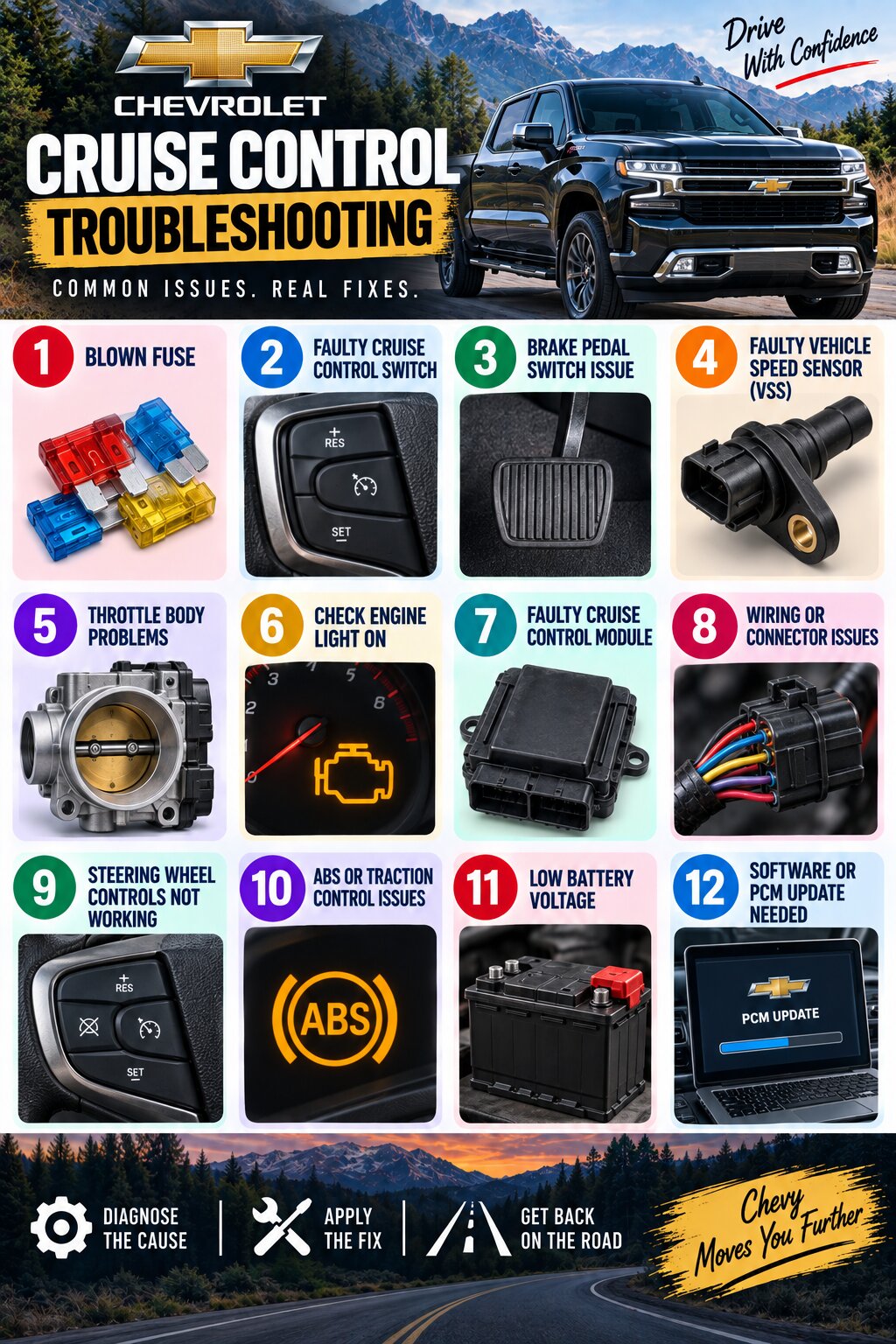
- Blown fuse
- Faulty brake switch
- Failed steering wheel controls
- Throttle body issues
- Wheel speed sensor problems
- ABS faults
- Check Engine Light
- Low battery voltage
Chevrolet diagnostic information shows that cruise control often becomes disabled when required safety inputs are missing or outside acceptable limits.
Fix
- Verify vehicle speed exceeds activation speed.
- Confirm cruise control is switched ON.
- Check brake light operation.
- Inspect cruise-related fuses.
- Scan for diagnostic trouble codes.
Cruise Control Turns Off Randomly
Another common complaint is cruise control disengaging unexpectedly while driving.
Possible Causes
- Brake switch malfunction
- ABS sensor faults
- StabiliTrak issues
- Poor battery connections
- BCM communication errors
- Vehicle speed sensor problems
GM diagnostic information identifies brake switch and speed sensor faults as major causes of cruise control cancellation. (DiagnostData)
Fix
- Check brake light switch operation.
- Scan ABS and BCM modules.
- Inspect wheel speed sensors.
- Verify battery terminals are clean and secure.
Cruise Control Light Comes On but Won’t Set Speed
Sometimes the cruise indicator illuminates, but pressing SET does nothing.
Possible Causes
- Faulty SET/COAST switch
- Steering wheel button failure
- Spiral cable (clock spring) fault
- Cruise switch wiring problem
Fix
- Test steering wheel controls.
- Inspect clock spring.
- Verify switch continuity.
Cruise switch failures are a common issue on many Chevrolet models. (RepairPal.com)
Cruise Control Speed Fluctuates
If the vehicle cannot maintain a steady speed, several systems may be responsible.
Possible Causes
- Vehicle speed sensor fault
- Electronic throttle issues
- Engine performance problems
- ECM software issues
Symptoms
- Surging
- Speed hunting
- Inconsistent acceleration
Fix
- Scan engine module.
- Inspect throttle body.
- Check speed sensor data.
Faulty throttle and sensor inputs are among the most frequently reported causes.
Cruise Control Stops Working After Check Engine Light Appears
Many Chevy owners are surprised to learn that unrelated engine faults can disable cruise control.
Why It Happens
The ECM may disable cruise control whenever it detects powertrain faults affecting safe operation.
Common examples include:
- Misfires
- Throttle body faults
- Accelerator pedal sensor issues
- Airflow sensor problems
Fix
Repair the engine-related fault first and clear diagnostic codes. Cruise control often resumes normal operation afterward.
Brake Switch Problems
Most Common Cruise Control Failure
The brake switch is arguably the most common cause of cruise control failure across Chevrolet vehicles.
The cruise system immediately disengages whenever it believes the brake pedal is pressed.
Symptoms
- Cruise control won’t engage
- Cruise disengages randomly
- Brake lights remain on
- Brake lights fail to illuminate
Fix
Replace the brake switch and verify proper adjustment.
GM service information repeatedly highlights brake switch diagnosis when troubleshooting cruise control complaints. (ChevroletForum)
Vehicle Speed Sensor Problems
Cruise control relies on accurate speed information.
A faulty speed sensor can disable:
- Cruise control
- ABS
- StabiliTrak
- Traction Control
Symptoms
- Speedometer issues
- ABS light
- StabiliTrak warning
- Cruise control failure
Fix
- Scan ABS module.
- Inspect speed sensor wiring.
- Replace defective sensor.
GM service documentation notes that speed-sensor interference or failure may cause erratic cruise operation.
Steering Wheel Switch Problems
Modern Chevrolet vehicles place cruise controls directly on the steering wheel.
Common Failures
- Worn buttons
- Internal switch failure
- Clock spring damage
- Connector issues
Symptoms
- Some buttons work, others don’t
- Cruise light won’t activate
- Intermittent operation
Fix
Inspect:
- Steering wheel controls
- Clock spring assembly
- Wiring connectors
ABS and StabiliTrak Problems
Many Chevrolet vehicles disable cruise control whenever the ABS or StabiliTrak system detects faults.
Common Causes
- Wheel speed sensor failure
- ABS module fault
- StabiliTrak communication issue
Symptoms
- ABS light illuminated
- Traction control warning
- Cruise control disabled
Fix
Address ABS or stability control codes first.
Cruise control usually returns after repairs are completed.
Adaptive Cruise Control Problems
Newer Chevrolet models may be equipped with Adaptive Cruise Control (ACC).
These systems use:
- Front camera
- Radar sensors
- GPS inputs
- Vehicle control modules
Common Adaptive Cruise Problems
Adaptive Cruise Unavailable
Possible causes include:
- Dirty camera lens
- Dirty radar sensor
- Poor weather
- Sensor calibration issue
Follow Distance Errors
May result from:
- Radar obstruction
- Camera misalignment
- Front-end collision damage
GM notes that dirt, snow, rain, fog, and blocked sensors can interfere with adaptive cruise operation. (Chevroletcanada)
Fix
- Clean sensors.
- Clean windshield camera area.
- Inspect front grille.
- Recalibrate sensors if necessary.
Super Cruise Troubleshooting
Certain premium Chevrolet models feature Super Cruise.
Reasons Super Cruise Becomes Unavailable
- Inactive OnStar subscription
- Dirty cameras
- GPS signal loss
- Driver monitoring issues
- Road not mapped for Super Cruise
Chevrolet states that camera visibility, GPS availability, and mapped roads are required for proper Super Cruise operation.
Model-Wise Chevy Cruise Control Troubleshooting Table
| Chevrolet Model | Common Problem | Most Likely Fix |
|---|---|---|
| Silverado 1500 | Brake switch failure | Replace brake switch |
| Silverado HD | Speed sensor fault | Diagnose ABS system |
| Tahoe | Steering wheel switch failure | Replace switch assembly |
| Suburban | BCM communication issue | Scan BCM |
| Equinox | Cruise won’t engage | Check brake switch |
| Traverse | Electronic communication fault | Scan BCM and ECM |
| Colorado | Wheel speed sensor issue | Replace faulty sensor |
| Malibu | Cruise disengages randomly | Test brake switch |
| Cruze | Sensor or throttle issue | Scan engine system |
| Impala | Cruise indicator on but won’t set | Test steering wheel controls |
| Trailblazer | StabiliTrak fault disabling cruise | Repair stability control issue |
| Blazer | Adaptive cruise unavailable | Clean radar and camera |
| Camaro | Cruise control intermittent | Inspect speed sensor |
| Corvette C7 | Adaptive cruise sensor issue | Recalibrate radar |
| Corvette C8 | ACC warning messages | Diagnose camera/radar system |
Silverado Cruise Control Problems
2007–2013 Silverado
Common issues:
- Brake switch failure
- Cruise switch faults
- Speed sensor problems
GM diagnostic procedures emphasize brake lamp circuit testing when cruise control becomes inoperative.
2014–2018 Silverado
Frequently reported issues include:
- BCM grounding problems
- Wheel speed sensor faults
- StabiliTrak warnings
2019+ Silverado
Most common concerns:
- Adaptive cruise calibration
- Camera faults
- Software updates
Equinox Cruise Control Problems
The Equinox often experiences:
- Brake switch failures
- Wheel speed sensor issues
- Electronic throttle faults
Symptoms
- Cruise won’t engage
- Check Engine Light
- StabiliTrak warning
Repairing the underlying fault usually restores cruise functionality.
Traverse Cruise Control Problems
Traverse owners frequently report:
- Cruise control disabled
- BCM communication issues
- Brake pedal sensor faults
Recent diagnostic guidance indicates that fail-safe mode is often triggered by brake sensor or network communication faults rather than the cruise system itself. (Car Mechan)
Tahoe and Suburban Cruise Control Problems
Common causes include:
- Brake switch failure
- Cruise switch issues
- BCM grounding problems
- Wheel speed sensor faults
GM technical guidance notes that poor BCM grounds can create intermittent cruise operation.
How to Diagnose Chevy Cruise Control Problems
Step 1: Check Brake Lights
Verify:
- Brake lights illuminate normally
- Brake lights do not remain stuck on
This simple test identifies many cruise-control-related issues.
Step 2: Check Fuses
Inspect:
- Cruise control fuse
- Stop lamp fuse
- BCM fuse
- ECM fuse
Replace blown fuses with the correct rating.
Step 3: Scan for Trouble Codes
Read codes from:
- ECM
- BCM
- ABS
- StabiliTrak
Many cruise control problems originate outside the cruise system itself.
Step 4: Check Wheel Speed Sensors
Inspect for:
- Damaged wiring
- Corrosion
- Fault codes
Step 5: Verify Battery Voltage
GM service information indicates cruise operation typically requires system voltage within normal operating range. (GM-Trucks.com)
Step 6: Inspect Steering Wheel Controls
Test:
- ON/OFF
- SET
- RESUME
- CANCEL
Replace faulty switches as needed.
Repair Costs
| Repair | Typical Cost |
|---|---|
| Fuse Replacement | $5–$25 |
| Brake Switch Replacement | $50–$200 |
| Cruise Switch Replacement | $100–$350 |
| Wheel Speed Sensor Replacement | $150–$400 |
| Clock Spring Replacement | $250–$700 |
| Throttle Body Replacement | $300–$900 |
| BCM Replacement | $500–$1,500 |
| Radar Calibration | $200–$600 |
| Adaptive Cruise Radar Replacement | $800–$2,500 |
| Diagnostic Scan | $75–$200 |
Preventing Cruise Control Problems
Maintain Battery Health
Low voltage can create numerous electronic issues.
Keep Sensors Clean
For adaptive cruise systems:
- Clean front grille sensors.
- Clean windshield camera areas.
Address ABS Warnings Promptly
Cruise control often depends on ABS data.
Replace Brake Switches When Symptoms Appear
A failing brake switch can cause intermittent cruise issues long before complete failure.
Perform Software Updates
GM periodically releases software updates that improve cruise control reliability and communication between modules. (ChevroletForum)
Frequently Asked Questions
Why won’t my Chevy cruise control engage?
The most common causes are brake switch failures, blown fuses, ABS faults, wheel speed sensor issues, and throttle-related problems.
Can a Check Engine Light disable cruise control?
Yes. Many Chevrolet vehicles automatically disable cruise control when certain powertrain fault codes are present.
Can a bad brake switch affect cruise control?
Yes. The brake switch is one of the most common reasons cruise control stops working.
Why does my cruise control turn off while driving?
Brake switch faults, wheel speed sensor issues, BCM communication problems, and ABS faults are common causes.
Why is Adaptive Cruise Control unavailable?
Dirty cameras, radar obstructions, poor weather conditions, calibration issues, or sensor faults can disable adaptive cruise control.
Can low battery voltage disable cruise control?
Yes. Insufficient voltage can cause communication and module faults that prevent cruise operation.
Final Thoughts
Chevrolet cruise control systems are highly integrated with the vehicle’s brake, ABS, throttle, and electronic control systems. While a failed cruise switch can certainly cause problems, the most common causes are actually brake switch faults, wheel speed sensor failures, ABS or StabiliTrak issues, throttle-related faults, and low battery voltage.
On newer Chevrolet models equipped with Adaptive Cruise Control or Super Cruise, dirty sensors, camera obstructions, and calibration problems become additional troubleshooting areas. By checking brake lights, scanning for diagnostic codes, inspecting fuses, and addressing ABS or engine warnings first, most Chevy cruise control problems can be diagnosed accurately and repaired without unnecessary parts replacement.