Feeling a vibration when accelerating in your Toyota Tacoma can be frustrating and concerning. Whether the vibration occurs during light acceleration, highway speeds, uphill driving, or under heavy throttle, it usually indicates a problem somewhere in the drivetrain, suspension, wheels, or engine.
While some vibrations may stem from minor issues such as tire imbalance, others can point to more serious problems involving the driveshaft, U-joints, transmission, or engine mounts. Identifying the source early can help prevent further damage and costly repairs.
This guide covers the most common causes of Toyota Tacoma vibration during acceleration, troubleshooting steps, repair costs, and model-specific issues.
Common Symptoms
Owners may notice:
- Vibration only during acceleration
- Shudder when accelerating from a stop
- Steering wheel vibration
- Seat or floorboard vibration
- Vibration at highway speeds
- Vibration when towing
- Driveline shudder under load
- Vibration while climbing hills
- Rumbling noise during acceleration
- Vehicle shaking between specific speeds
The symptoms can help narrow down the source of the problem.
Toyota Tacoma Vibration Symptoms by Model
| Tacoma Generation | Common Vibration Issues |
|---|---|
| 1995-2004 Tacoma | U-joints, driveshaft imbalance, worn engine mounts |
| 2005-2015 Tacoma | Carrier bearing wear, driveshaft vibration, tire issues |
| 2016-2023 Tacoma | Driveline vibration, torque converter shudder, wheel balance concerns |
| 2024+ Tacoma | Tire balance, driveline alignment, suspension-related vibration |
Worn or Damaged Driveshaft
One of the most common causes of acceleration-related vibration is a faulty driveshaft.
The driveshaft transfers power from the transmission to the differential. If it becomes bent, damaged, or out of balance, vibrations often appear during acceleration.
Symptoms
- Vibration increases with speed
- Floorboard vibration
- Vibration under load
- Clunking when shifting gears
Fixes
- Inspect driveshaft balance weights
- Check for physical damage
- Replace damaged driveshaft
- Rebalance driveshaft if necessary
Worn U-Joints
Universal joints (U-joints) allow the driveshaft to move with suspension travel.
As U-joints wear, they can create vibrations that become more noticeable during acceleration.
Symptoms
- Clunk when shifting
- Vibration during acceleration
- Squeaking noises
- Driveline looseness
Fixes
- Replace worn U-joints
- Lubricate serviceable U-joints
- Inspect driveshaft yokes
Carrier Bearing Problems
Many Tacoma models use a two-piece driveshaft with a center support bearing, also called a carrier bearing.
When the bearing wears out, vibrations often occur under acceleration.
Symptoms
- Vibration between 30 and 60 mph
- Driveline rumble
- Shudder under load
Fixes
- Replace carrier bearing
- Inspect driveshaft alignment
- Check mounting brackets
Tire Balance Issues
A simple tire balance problem can feel similar to a drivetrain vibration.
Improperly balanced tires often become noticeable during acceleration because additional torque loads the suspension.
Symptoms
- Steering wheel shake
- Vibration at specific speeds
- Smooth operation at lower speeds
Fixes
- Dynamic wheel balancing
- Road-force balancing
- Tire inspection
Tire Problems
Damaged or unevenly worn tires can create vibrations.
Common issues include:
- Cupping
- Broken belts
- Uneven wear
- Out-of-round tires
Fixes
- Tire replacement
- Tire rotation
- Alignment correction
Bent Wheels
Off-road driving can damage wheels, particularly on Tacoma models frequently used on trails.
Symptoms
- Steering wheel vibration
- Vibration worsening with speed
- Visible wheel damage
Fixes
- Wheel repair
- Wheel replacement
- Tire balancing after repair
Engine Misfire
Not all acceleration vibrations originate from the drivetrain.
A misfiring engine can create shaking that feels like a driveline vibration.
Symptoms
- Check Engine Light
- Rough idle
- Power loss
- Hesitation
Common Causes
- Worn spark plugs
- Bad ignition coils
- Fuel injector issues
- Vacuum leaks
Fixes
- Scan diagnostic codes
- Replace spark plugs
- Test ignition coils
- Inspect fuel system
Engine Mount Failure
Engine mounts isolate engine vibrations from the frame.
When mounts deteriorate, vibration can transfer into the cabin during acceleration.
Symptoms
- Engine movement
- Excess vibration under load
- Clunking sounds
Fixes
- Replace damaged mounts
- Inspect transmission mounts
Transmission Problems
Transmission issues can create vibration during acceleration.
Symptoms
- Shudder during gear changes
- Delayed shifting
- Jerking when accelerating
Common Causes
- Low transmission fluid
- Internal wear
- Torque converter problems
Fixes
- Check fluid level
- Replace transmission fluid
- Diagnose transmission components
Torque Converter Shudder
Many Tacoma owners report torque converter shudder that feels similar to driving over rumble strips.
Symptoms
- Vibration around 35-60 mph
- Shudder during light acceleration
- Intermittent vibration
Fixes
- Transmission fluid replacement
- Software updates
- Torque converter replacement
Differential Problems
The rear differential plays a major role in transferring power.
Worn gears or bearings can create acceleration vibrations.
Symptoms
- Whining noises
- Vibration under load
- Gear noise
Fixes
- Differential inspection
- Bearing replacement
- Gear replacement
Axle Shaft Problems
Damaged axle shafts can cause vibration, especially after off-road impacts.
Symptoms
- Vibration under acceleration
- Clicking noises
- Uneven tire wear
Fixes
- Inspect axle shafts
- Replace damaged components
Suspension Component Wear
Worn suspension parts can amplify drivetrain vibrations.
Components to Inspect
- Ball joints
- Control arms
- Bushings
- Shocks
- Struts
Fixes
- Replace worn suspension parts
- Perform alignment
Lift Kit and Modification Issues
Many Tacoma owners install:
- Lift kits
- Larger tires
- Suspension modifications
Improper installation can alter driveline angles and create vibrations.
Symptoms
- Vibration after lift installation
- Highway-speed shaking
- Driveshaft vibration
Fixes
- Correct driveline angles
- Install carrier bearing drop kit
- Adjust pinion angle
Wheel Alignment Problems
Improper alignment may contribute to vibrations and uneven tire wear.
Symptoms
- Pulling to one side
- Uneven tire wear
- Steering wheel vibration
Fixes
- Four-wheel alignment
- Tire inspection
Brake Rotor Issues
Although brake rotors primarily affect braking, severely warped rotors can contribute to vibration.
Symptoms
- Vibration while braking
- Pulsating brake pedal
Fixes
- Rotor resurfacing
- Rotor replacement
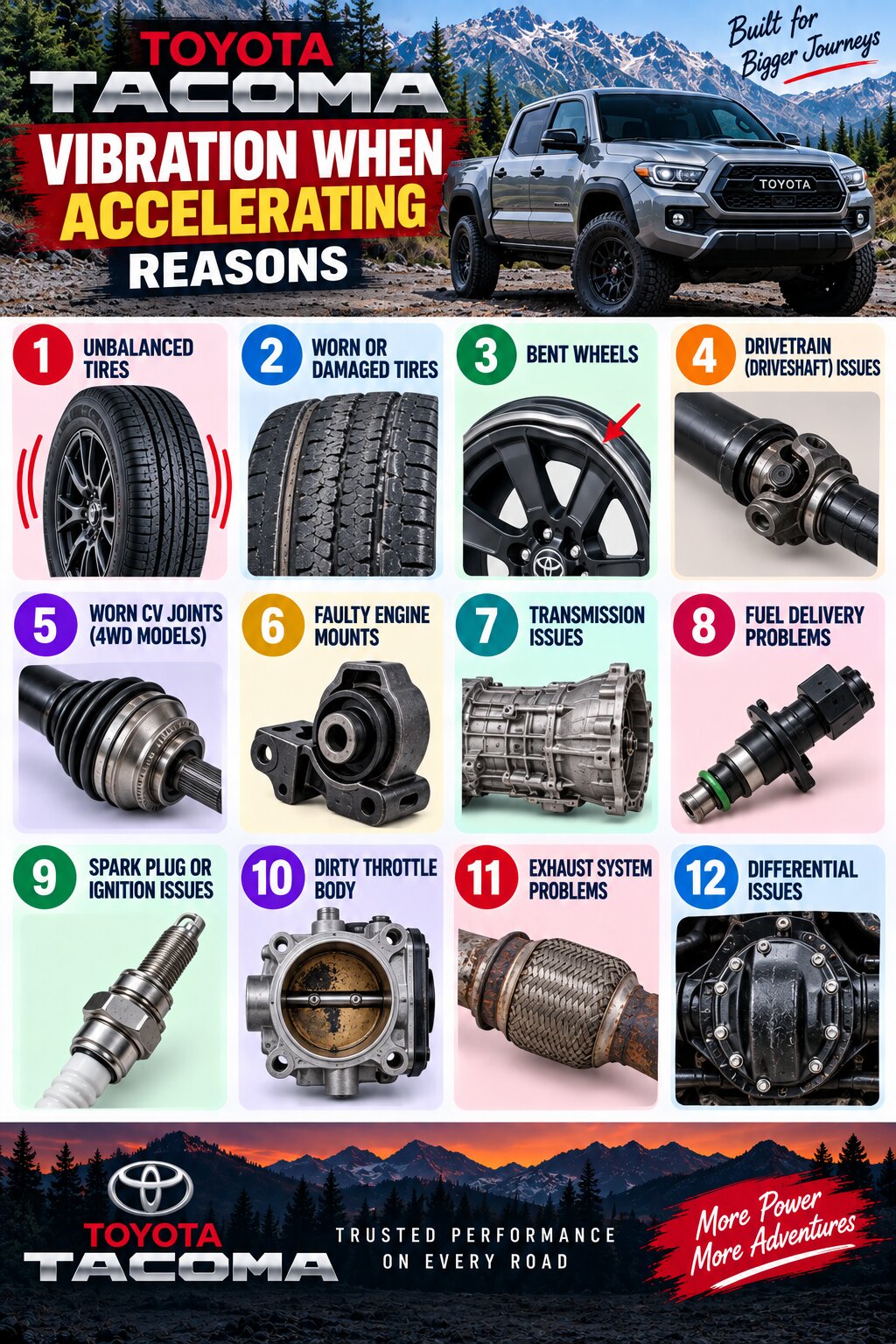
Model-Specific Tacoma Vibration Problems
2005-2015 Tacoma
Common issues include:
- Carrier bearing wear
- Driveshaft vibration
- U-joint failure
2016-2023 Tacoma
Frequently reported concerns include:
- Torque converter shudder
- Driveshaft imbalance
- Tire balancing issues
Lifted Tacoma Models
Often experience:
- Driveline angle problems
- Carrier bearing vibration
- Driveshaft harmonics
Diagnosing Tacoma Vibration During Acceleration
Step 1: Determine Speed Range
Ask:
- Does vibration occur at all speeds?
- Only at highway speeds?
- Only during acceleration?
Step 2: Check Tires
Inspect for:
- Uneven wear
- Missing wheel weights
- Tire damage
Step 3: Inspect Driveshaft
Look for:
- Loose U-joints
- Missing balance weights
- Physical damage
Step 4: Scan for Engine Codes
Check for:
- Misfires
- Fuel system faults
- Ignition problems
Step 5: Test Transmission Operation
Observe:
- Shift quality
- Shuddering
- Fluid condition
Estimated Repair Costs
| Repair | Typical Cost |
|---|---|
| Tire Balance | $20-$100 |
| Alignment | $80-$250 |
| U-Joint Replacement | $150-$500 |
| Carrier Bearing Replacement | $300-$900 |
| Driveshaft Replacement | $500-$1,500 |
| Engine Mount Replacement | $300-$1,000 |
| Torque Converter Replacement | $1,000-$3,500 |
| Differential Repair | $800-$3,000 |
Actual costs vary by model year and location.
How to Prevent Tacoma Acceleration Vibrations
Regular Maintenance
- Rotate tires
- Balance wheels
- Maintain alignment
Inspect Driveline Components
Regularly check:
- U-joints
- Driveshaft
- Carrier bearing
Avoid Off-Road Impact Damage
Inspect the undercarriage after:
- Rock crawling
- Trail riding
- Hard impacts
Service Transmission
Follow Toyota’s maintenance recommendations for transmission fluid changes.
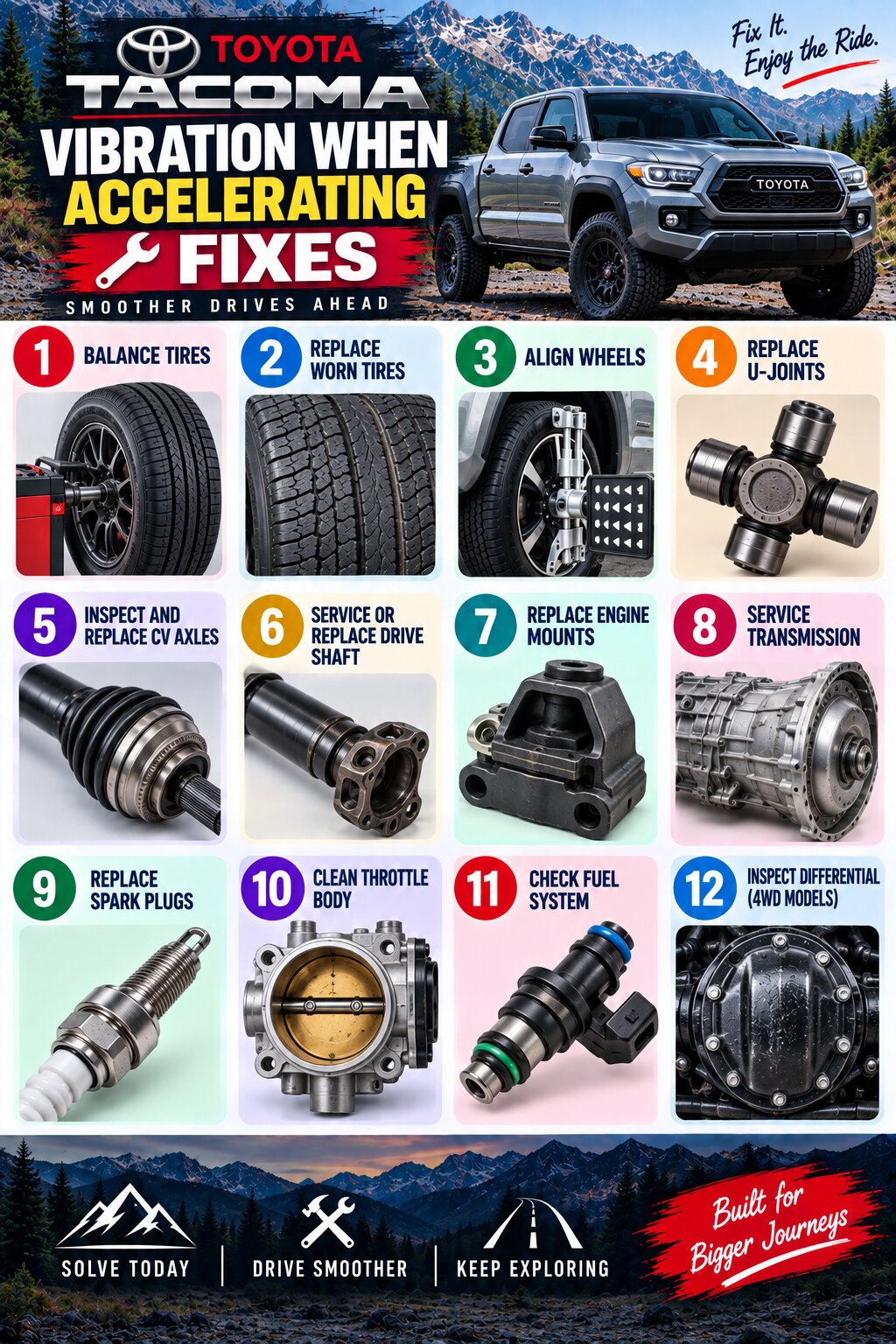
Frequently Asked Questions
Why does my Toyota Tacoma vibrate when I accelerate?
Common causes include driveshaft issues, worn U-joints, tire imbalance, engine misfires, torque converter shudder, and differential problems.
Can bad tires cause vibration during acceleration?
Yes. Uneven wear, broken belts, and poor balancing can create vibrations that become more noticeable under acceleration.
Is Tacoma torque converter shudder common?
Some Tacoma owners have reported torque converter shudder, especially during light acceleration at moderate speeds.
Can a lifted Tacoma cause vibration?
Yes. Lift kits can alter driveline angles and create vibration if not properly corrected.
Is it safe to drive with acceleration vibration?
Minor tire-related vibration may not pose an immediate danger, but drivetrain or brake-related vibrations should be diagnosed promptly.
Can a bad driveshaft cause vibration only during acceleration?
Yes. Driveshaft imbalance and worn U-joints commonly produce vibrations that are most noticeable under load.
Final Thoughts
Toyota Tacoma vibration during acceleration can originate from several systems, including the tires, driveshaft, U-joints, carrier bearing, engine, transmission, or differential. In many cases, the cause is relatively straightforward, such as tire imbalance or worn driveline components. However, persistent vibrations should never be ignored, as they can worsen over time and lead to more expensive repairs. By identifying when the vibration occurs, inspecting key components, and addressing issues early, Tacoma owners can restore smooth operation and prevent further drivetrain damage.