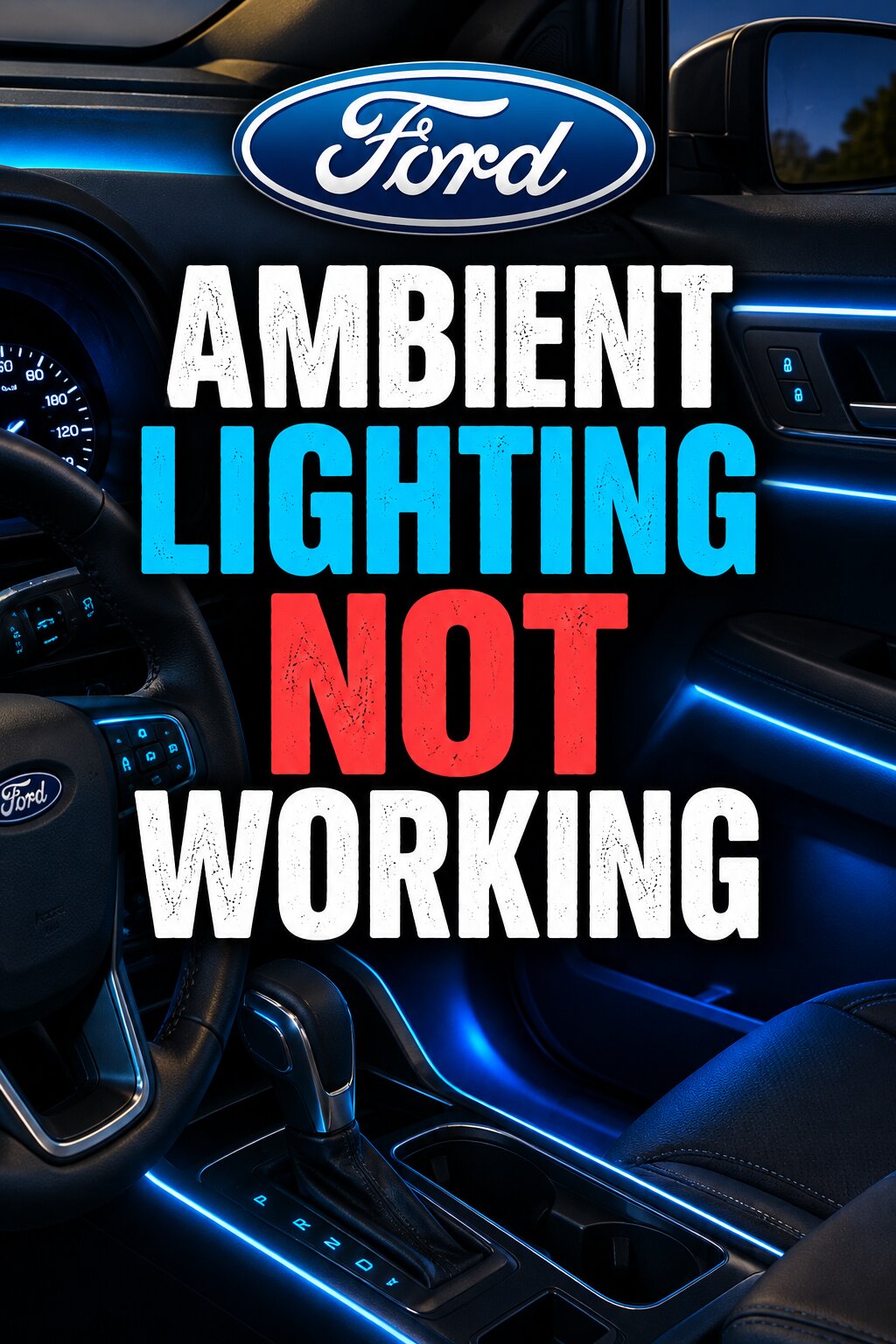
Ford’s ambient lighting system adds a premium touch to the cabin by illuminating footwells, cup holders, door panels, storage compartments, and other interior areas with customizable colors. Available on many Ford vehicles including the F-150, Explorer, Expedition, Edge, Escape, Mustang, Ranger, Bronco, and Lincoln models, ambient lighting has become a popular comfort and convenience feature.
However, owners occasionally encounter situations where the ambient lighting stops working, becomes dim, displays the wrong color, flickers, or fails completely. In some cases, only certain lighting zones stop working, while in others the entire system becomes inoperative.
Fortunately, most ambient lighting issues can be traced to a handful of common causes, including software glitches, incorrect settings, blown fuses, wiring faults, failed LED modules, or control module problems.
This guide explains the most common reasons Ford ambient lighting stops working, how to diagnose the issue, and the possible repair solutions.
How Ford Ambient Lighting Works
Ford’s ambient lighting system uses LED light modules installed throughout the vehicle’s interior.
Depending on the model, the system may illuminate:
- Front footwells
- Rear footwells
- Door handles
- Door storage pockets
- Cup holders
- Dashboard trim
- Center console
- Storage compartments
The lighting is controlled through:
- SYNC infotainment system
- Instrument cluster settings
- Body Control Module (BCM)
- Interior lighting modules
Some vehicles allow drivers to select multiple colors and brightness levels through the vehicle settings menu.
Because the system relies on several electronic components working together, failures can occur in multiple locations.
Common Symptoms
Owners commonly report:
- Ambient lighting completely inoperative
- One lighting zone not working
- Certain colors missing
- Flickering ambient lights
- Lights stuck on one color
- Ambient lighting dimmer than normal
- Lighting turns off randomly
- Ambient lighting stopped working after battery replacement
- Ambient lighting disappeared from SYNC menu
- Only cup holder or footwell lights not working
The specific symptoms often help identify the root cause.
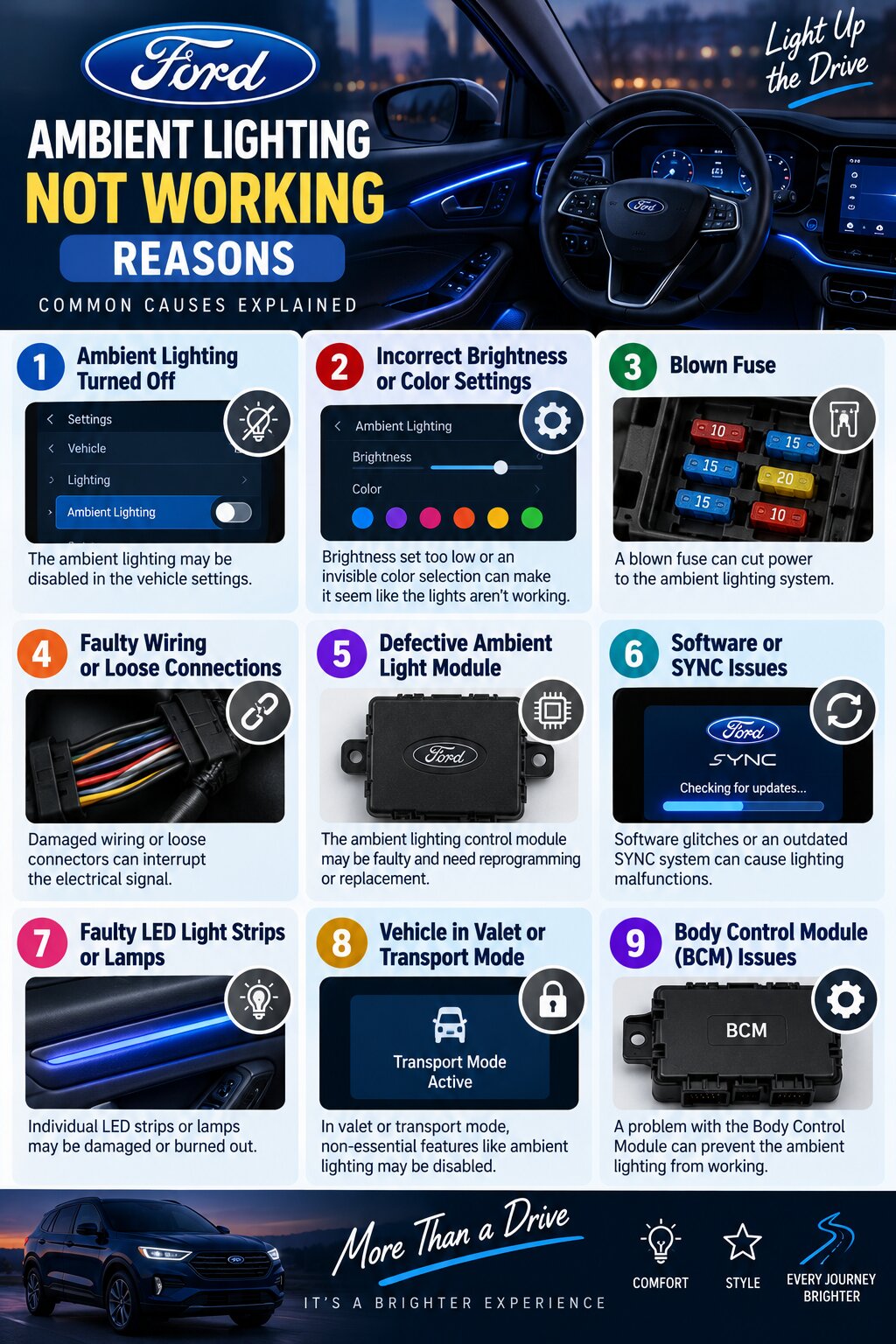
Ambient Lighting Turned Off in Settings
One of the most common causes is simply an incorrect setting.
Many Ford vehicles allow ambient lighting to be:
- Disabled
- Dimmed
- Color customized
Sometimes software updates, battery disconnections, or accidental menu changes can disable the feature.
Symptoms
- No ambient lighting
- No warning messages
- Other interior lights operate normally
Fix
Navigate to:
Settings → Vehicle Settings → Ambient Lighting
Verify:
- Ambient lighting is enabled
- Brightness level is not set to zero
- Desired color is selected
Many owners discover the issue is simply a settings change rather than a hardware failure.
SYNC Software Glitches
Ford’s SYNC infotainment system controls many interior functions, including ambient lighting on certain models.
Software glitches can prevent communication between modules.
Symptoms
- Ambient lighting menu disappears
- Colors cannot be changed
- Lighting stops responding
- System behaves erratically
Fixes
Restart SYNC
Many models allow a soft reset.
Perform Master Reset
A master reset can restore lost settings and module communication.
Install Software Updates
Ford periodically releases software updates that address infotainment and lighting-related issues.
If the problem started after a software update, checking for newer updates may help.
Blown Fuse
The ambient lighting system depends on electrical protection through one or more fuses.
A blown fuse can disable:
- Entire ambient lighting system
- Individual lighting circuits
- Interior lighting modules
Symptoms
- Complete loss of ambient lighting
- Multiple interior lighting features affected
Fix
Consult the owner’s manual for the correct fuse locations.
Inspect:
- Interior fuse box
- Passenger compartment fuse panel
- Body control-related fuses
Replace any blown fuse with the correct amperage rating.
If the replacement fuse blows again, further diagnosis is needed.
Low Battery Voltage
Modern Ford vehicles are highly dependent on stable voltage.
Low battery voltage can cause various electronic features to malfunction.
Symptoms
- Intermittent ambient lighting
- Random lighting shutdown
- Other electrical issues
- Problems after vehicle sits for extended periods
Common Causes
- Weak battery
- Faulty alternator
- Corroded battery terminals
Fixes
- Test battery condition
- Clean battery terminals
- Test charging system
- Replace weak battery
Many lighting problems disappear once proper voltage is restored.
Failed LED Module
Ambient lighting systems use LED modules rather than traditional bulbs.
Although LEDs generally last much longer than incandescent bulbs, failures can still occur.
Symptoms
- One lighting zone not working
- One color missing
- Dim lighting in specific area
Common Locations
- Footwell lights
- Cup holder lights
- Door pocket lights
- Console lights
Fix
Replace the failed LED module.
Depending on the vehicle, individual LEDs or complete lighting assemblies may be serviced.
Wiring Problems
Damaged wiring is another common cause of ambient lighting failure.
Common Causes
- Loose connectors
- Corrosion
- Pinched wires
- Rodent damage
- Water intrusion
Symptoms
- Intermittent operation
- Flickering lights
- Some zones not functioning
Fix
Inspect:
- Connectors
- Wiring harnesses
- Ground points
Repair or replace damaged wiring as needed.
Body Control Module (BCM) Problems
The Body Control Module manages many vehicle lighting functions.
If the BCM develops a fault, ambient lighting may stop functioning properly.
Symptoms
- Multiple lighting issues
- Interior lighting malfunctions
- Random operation
- Communication fault codes
Fixes
- Scan BCM for codes
- Update BCM software
- Replace BCM if necessary
Module replacement generally requires programming using Ford diagnostic equipment.
Ambient Lighting Not Working After Battery Replacement
Some owners notice ambient lighting problems immediately after replacing the battery.
Why It Happens
Battery replacement may:
- Reset module settings
- Trigger software glitches
- Interrupt module communication
Fixes
- Perform vehicle reset procedures
- Check ambient lighting settings
- Update module software
- Clear stored fault codes
Often the issue resolves after a short drive cycle or module reset.
Water Damage
Water intrusion can affect ambient lighting components.
Common Sources
- Sunroof drains
- Door seals
- Windshield leaks
- Flood damage
Symptoms
- Flickering lights
- Intermittent operation
- Corrosion-related faults
Fixes
- Locate leak source
- Dry affected areas
- Replace damaged modules or wiring
Ignoring water leaks can lead to additional electrical problems.
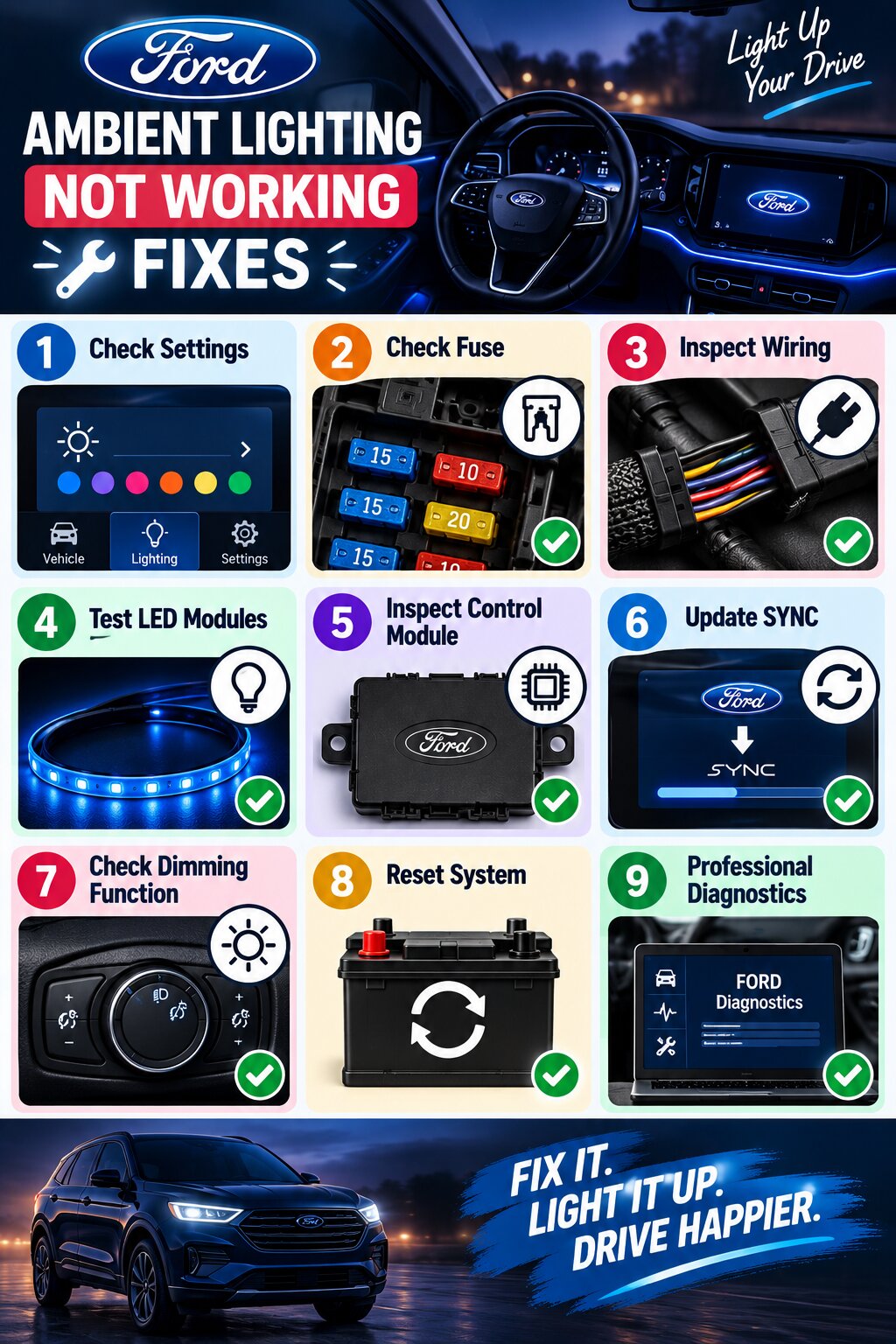
Ford F-150 Ambient Lighting Not Working
The F-150 is among the most commonly reported Ford models for ambient lighting concerns.
Common Causes
- SYNC software issues
- LED module failures
- BCM faults
- Fuse problems
Frequently Affected Areas
- Cup holders
- Footwells
- Door pockets
Typical Fixes
- Software reset
- Fuse replacement
- LED replacement
Ford Explorer Ambient Lighting Not Working
Explorer owners frequently report:
- Missing color options
- Lighting menu issues
- Partial lighting failure
Common Solutions
- Master SYNC reset
- Software updates
- LED module replacement
Ford Edge Ambient Lighting Problems
Common complaints include:
- Flickering lights
- One side not working
- Incorrect colors
Likely Causes
- Wiring issues
- LED failures
- BCM communication problems
Ford Mustang Ambient Lighting Issues
Mustang ambient lighting systems often include:
- Footwell lighting
- Cup holder lighting
- Accent trim lighting
Common Problems
- Color selection issues
- Intermittent operation
- Software-related failures
Solutions
- Verify settings
- Update SYNC software
- Replace defective modules
Ford Expedition Ambient Lighting Problems
Expedition owners may experience:
- Rear ambient lights not working
- Dim lighting
- Complete system failure
Common Causes
- Module faults
- Fuse failures
- Wiring issues
Diagnosing Ambient Lighting Problems
Step 1: Check Settings
Verify:
- Ambient lighting is enabled
- Brightness is above minimum
- Color selection is active
Step 2: Check Battery Condition
Low voltage can create unusual electrical symptoms.
Step 3: Inspect Fuses
Locate all lighting-related fuses.
Step 4: Test Individual Lighting Zones
Determine whether:
- Entire system is affected
- One zone is affected
- One color is affected
Step 5: Scan for Diagnostic Codes
A professional scan tool can identify:
- BCM faults
- Communication errors
- Lighting module failures
Estimated Repair Costs
| Repair | Typical Cost |
|---|---|
| Fuse Replacement | $10-$50 |
| Battery Replacement | $150-$400 |
| LED Module Replacement | $50-$300 |
| Wiring Repair | $100-$500 |
| BCM Programming | $100-$300 |
| BCM Replacement | $400-$1,200 |
| Dealer Diagnostic Fee | $100-$250 |
Actual costs vary by model and location.
Preventing Ambient Lighting Problems
Keep Software Updated
Install available Ford software updates.
Maintain Battery Health
Weak batteries often trigger electronic issues.
Address Water Leaks Quickly
Prevent moisture from reaching electrical components.
Avoid DIY Wiring Modifications
Aftermarket electronics can interfere with factory lighting systems.
Inspect Interior Electronics Regularly
Early detection helps prevent larger electrical repairs.
Frequently Asked Questions
Why did my Ford ambient lighting stop working?
The most common causes include disabled settings, software glitches, blown fuses, low battery voltage, failed LED modules, wiring faults, or BCM issues.
Why is only one ambient light color working?
This often indicates a failed LED module or a software-related issue affecting color control.
Can a weak battery affect ambient lighting?
Yes. Low voltage can cause many electronic systems, including ambient lighting, to malfunction.
Why did ambient lighting stop working after a battery change?
Battery replacement can reset vehicle modules and settings, sometimes requiring a system reset or software update.
Can a blown fuse disable ambient lighting?
Yes. A blown fuse may disable part or all of the ambient lighting system.
Does the Body Control Module control ambient lighting?
In most Ford vehicles, the BCM plays a major role in managing ambient lighting and other interior electrical functions.
Conclusion
Ford ambient lighting systems add style and convenience to the cabin, but they can occasionally develop problems ranging from simple settings issues to more complex electrical faults. The most common causes include disabled lighting settings, software glitches, blown fuses, weak batteries, faulty LED modules, damaged wiring, and Body Control Module failures.
Fortunately, many issues can be diagnosed systematically by checking settings, inspecting fuses, testing battery voltage, and scanning for fault codes. Addressing problems early can help restore full functionality and prevent more extensive electrical repairs in the future.