Toyota Tacoma trucks are known for reliability, but vibration complaints are fairly common across multiple generations. Vibrations may occur at idle, during acceleration, at highway speeds, while braking, or during deceleration. The key to diagnosing the problem is identifying when the vibration occurs and where it is felt—steering wheel, seat, floorboard, pedals, or entire truck.
Common Tacoma Vibration Symptoms
Owners commonly report:
- Steering wheel shake at highway speeds
- Vibration during acceleration
- Seat or floorboard vibration
- Driveline shudder
- Vibration while towing
- Idle vibration
- Vibration after installing a lift kit
- Brake pedal pulsation
- Vibration between 10–30 mph or 30–10 mph during deceleration on some models
Toyota Tacoma Vibration Causes and Fixes
| Cause | Common Symptoms | Typical Fix |
|---|---|---|
| Tire imbalance | Steering wheel shake at highway speeds | Wheel balancing |
| Uneven tire wear | Speed-related vibration | Tire replacement/rotation |
| Bent wheel | Constant vibration | Wheel repair or replacement |
| Worn U-joints | Acceleration vibration | Replace U-joints |
| Carrier bearing failure | Floorboard vibration | Replace carrier bearing |
| Driveshaft imbalance | Vibration under load | Rebalance or replace driveshaft |
| Engine mounts | Idle vibration | Replace mounts |
| Wheel bearing failure | Humming and vibration | Replace bearing |
| Suspension wear | Front-end vibration | Replace worn components |
| Lift kit geometry issues | Driveline vibration | Correct driveline angles |
| Differential issues | Vibration and whining | Differential repair |
| Brake rotor warping | Vibration when braking | Replace rotors |
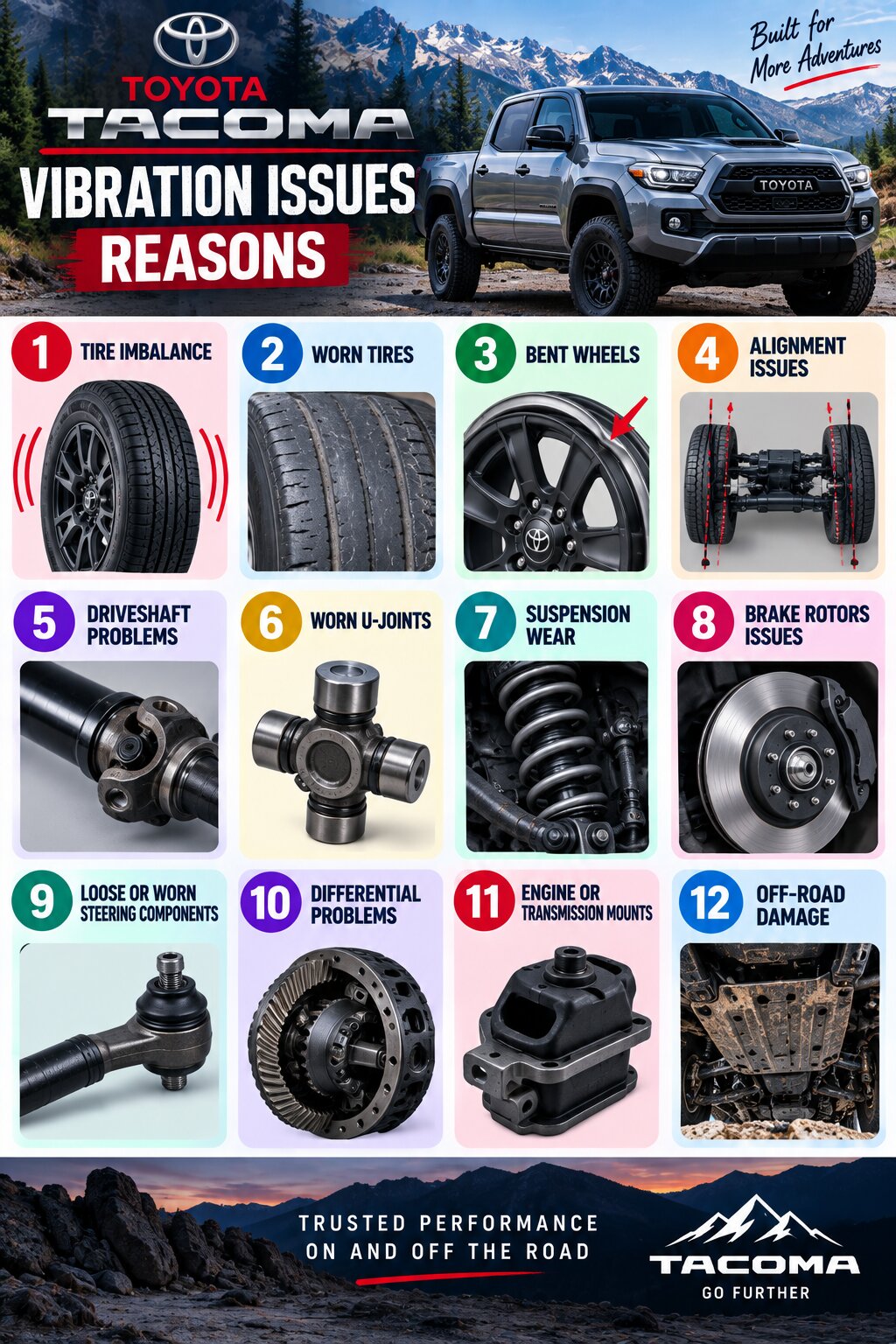
Tire and Wheel Problems
The most common Tacoma vibration source is the wheel and tire assembly.
Symptoms
- Steering wheel shakes at 55–75 mph
- Vibration worsens as speed increases
- No vibration at idle
Common causes include:
- Tire imbalance
- Uneven tire wear
- Bent wheels
- Incorrect tire pressure
- Broken tire belts
Many Tacoma vibration complaints are resolved with proper balancing, particularly road-force balancing.
Fixes
- Balance all four tires
- Inspect for tire defects
- Check wheel runout
- Verify tire pressure
- Perform alignment
Driveshaft Problems
Tacomas use a relatively complex driveshaft system, especially on 4WD models.
A damaged or imbalanced driveshaft can create vibration during acceleration and at highway speeds. Tacoma owners frequently report driveline-related vibrations, particularly after suspension modifications.
Symptoms
- Floorboard vibration
- Vibration under acceleration
- Shudder while towing
- Vibration increasing with speed
Fixes
- Inspect driveshaft balance weights
- Check driveshaft runout
- Replace damaged driveshaft
- Rebalance driveshaft
Worn U-Joints
Universal joints allow the driveshaft to flex with suspension movement.
When they wear, vibration often appears during acceleration.
Symptoms
- Clunk when shifting
- Acceleration vibration
- Driveline shudder
Fixes
- Replace U-joints
- Inspect yokes and driveshaft connections
Carrier Bearing Failure
Many Tacoma models use a center support bearing.
A worn carrier bearing is a common cause of vibration.
Symptoms
- Vibration around 30–60 mph
- Floorboard shaking
- Rumbling noise
Fixes
- Replace carrier bearing
- Inspect driveshaft alignment
Lift Kit and Suspension Modification Issues
Lifted Tacomas frequently develop driveline vibrations because the suspension lift changes driveshaft operating angles. Improper geometry can accelerate wear on bearings and joints.
Symptoms
- Vibration after installing lift
- Driveline shudder
- Highway vibration
Fixes
- Carrier bearing drop kit
- Pinion angle correction
- Driveshaft modification
- Professional suspension alignment
Engine Mount Problems
Engine mounts isolate engine vibration from the frame.
Worn mounts allow excessive engine movement that transfers vibration into the cabin. Repair data consistently identifies worn engine mounts as a leading cause of Tacoma engine vibration.
Symptoms
- Vibration at idle
- Excess shaking during acceleration
- Engine movement when revving
Fixes
- Replace engine mounts
- Inspect transmission mounts
Engine Misfires
An engine misfire can feel like a drivetrain vibration.
Symptoms
- Rough idle
- Check Engine Light
- Hesitation during acceleration
- Loss of power
Common Causes
- Bad spark plugs
- Ignition coil failure
- Fuel injector issues
- Vacuum leaks
Fixes
- Scan trouble codes
- Replace ignition components
- Clean fuel system
Harmonic Balancer Problems
The harmonic balancer reduces engine vibrations.
If it becomes damaged or warped, vibration may occur throughout the RPM range. (RepairPal)
Symptoms
- Engine vibration at idle
- Vibration increases with RPM
- Belt noise
Fixes
- Replace harmonic balancer
Wheel Bearing Failure
Failing wheel bearings can cause both vibration and noise.
Symptoms
- Humming noise
- Steering wheel vibration
- Noise while turning
Fixes
- Replace wheel bearing assembly
Suspension and Steering Wear
Worn suspension components can amplify vibration.
Components to Inspect
- Ball joints
- Tie rods
- Control arm bushings
- Sway bar links
- Shocks and struts
Tacoma owners frequently trace persistent front-end vibration to worn suspension or steering components. (Tacoma World)
Fixes
- Replace worn components
- Perform alignment
Differential and Axle Issues
A worn differential or damaged axle can create vibration under load.
Symptoms
- Vibration during acceleration
- Whining noise
- Clunking sounds
Fixes
- Differential inspection
- Replace bearings or gears
- Replace damaged axle shafts
Toyota Technical Service Bulletin (TSB) Vibration Issues
Toyota has issued Technical Service Bulletins addressing driveline vibration on certain Tacoma models.
Affected Models
Primarily:
- 2016–2023 Tacoma
- 4WD models
- 6-speed automatic transmission
Toyota notes vibration felt in the seat, floorboard, or steering wheel during deceleration in some vehicles and provides repair procedures through dealer service departments.
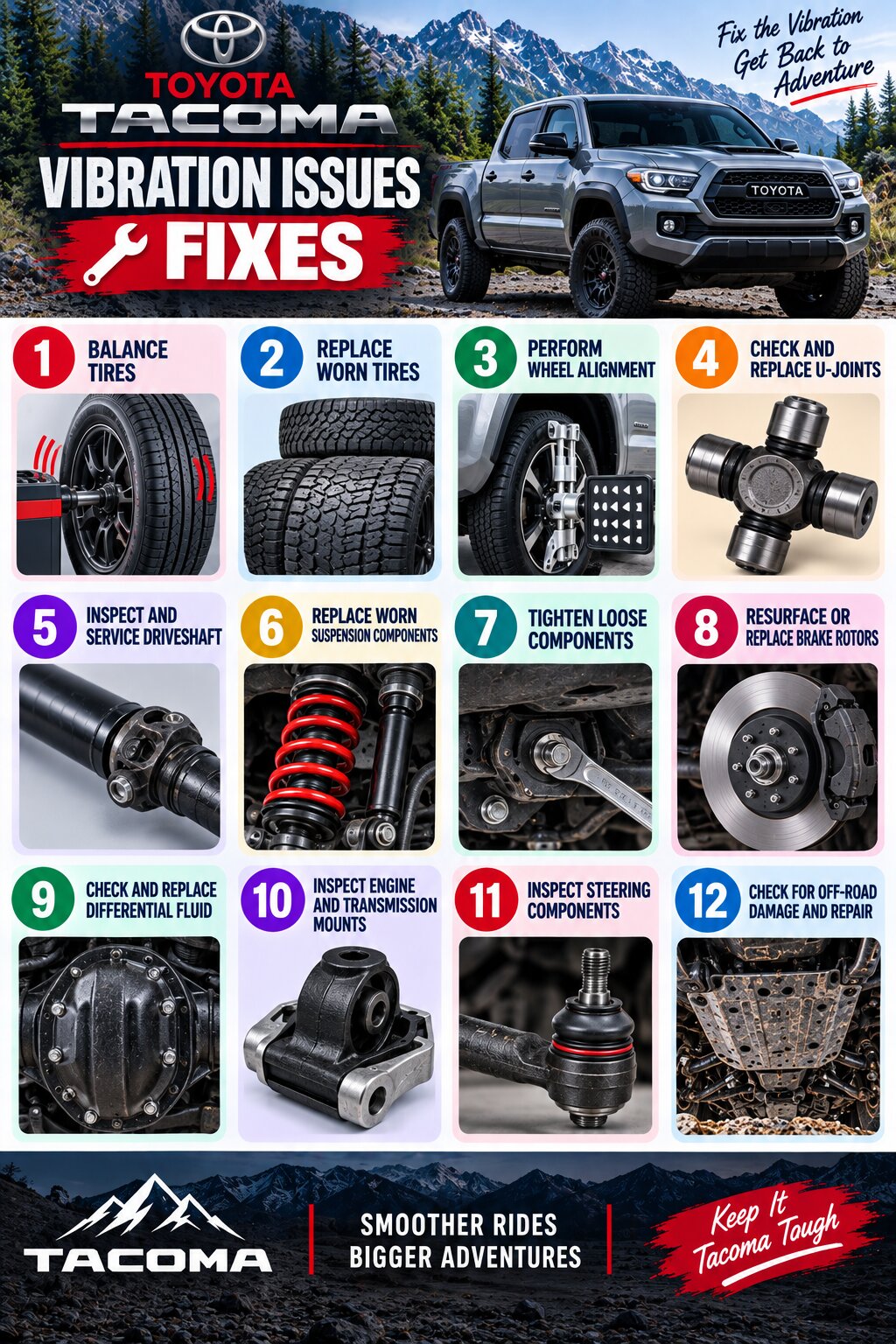
Diagnosing Tacoma Vibration
If Vibration Happens at Idle
Check:
- Engine mounts
- Harmonic balancer
- Misfires
- Accessory pulleys
If Vibration Happens During Acceleration
Check:
- Driveshaft
- U-joints
- Carrier bearing
- Differential
- Axles
If Vibration Happens at Highway Speeds
Check:
- Tire balance
- Wheel damage
- Wheel bearings
- Alignment
If Vibration Happens During Braking
Check:
- Brake rotors
- Brake calipers
- Wheel bearings
Estimated Repair Costs
| Repair | Typical Cost |
|---|---|
| Tire Balance | $20–$120 |
| Alignment | $100–$250 |
| Wheel Bearing | $250–$700 |
| U-Joint Replacement | $150–$500 |
| Carrier Bearing | $300–$900 |
| Driveshaft Replacement | $600–$1,800 |
| Engine Mount Replacement | $300–$1,200 |
| Differential Repair | $800–$3,500 |
| Brake Rotor Replacement | $250–$900 |
Frequently Asked Questions
Why does my Toyota Tacoma vibrate at highway speeds?
The most common causes are tire imbalance, uneven tire wear, bent wheels, alignment issues, or wheel bearing problems. (WheelsJoint)
Why does my Tacoma vibrate during acceleration?
Common causes include worn U-joints, carrier bearing failure, driveshaft imbalance, differential issues, or engine misfires. (TACOMABEAST)
Why does my lifted Tacoma vibrate?
Lift kits alter driveline geometry and driveshaft angles, which can create driveline vibration if corrections are not made.
Can bad engine mounts cause Tacoma vibration?
Yes. Worn engine mounts are among the most common causes of engine-related vibration in Tacoma trucks. (RepairPal)
Is Tacoma driveline vibration common?
Yes. Certain Tacoma generations have known driveline vibration complaints, and Toyota has issued technical service bulletins for specific models. (NHTSA Static)
Final Thoughts
Toyota Tacoma vibration issues can stem from several different systems, including tires, wheels, driveshafts, U-joints, carrier bearings, engine mounts, suspension components, and differentials. The most effective way to diagnose the problem is to identify when the vibration occurs—idle, acceleration, highway speeds, braking, or deceleration.
Starting with the simplest causes such as tire balance and alignment often saves time and money, while persistent vibrations may require a detailed inspection of the driveline and suspension. Early diagnosis can prevent more extensive damage and keep your Tacoma riding smoothly for years.