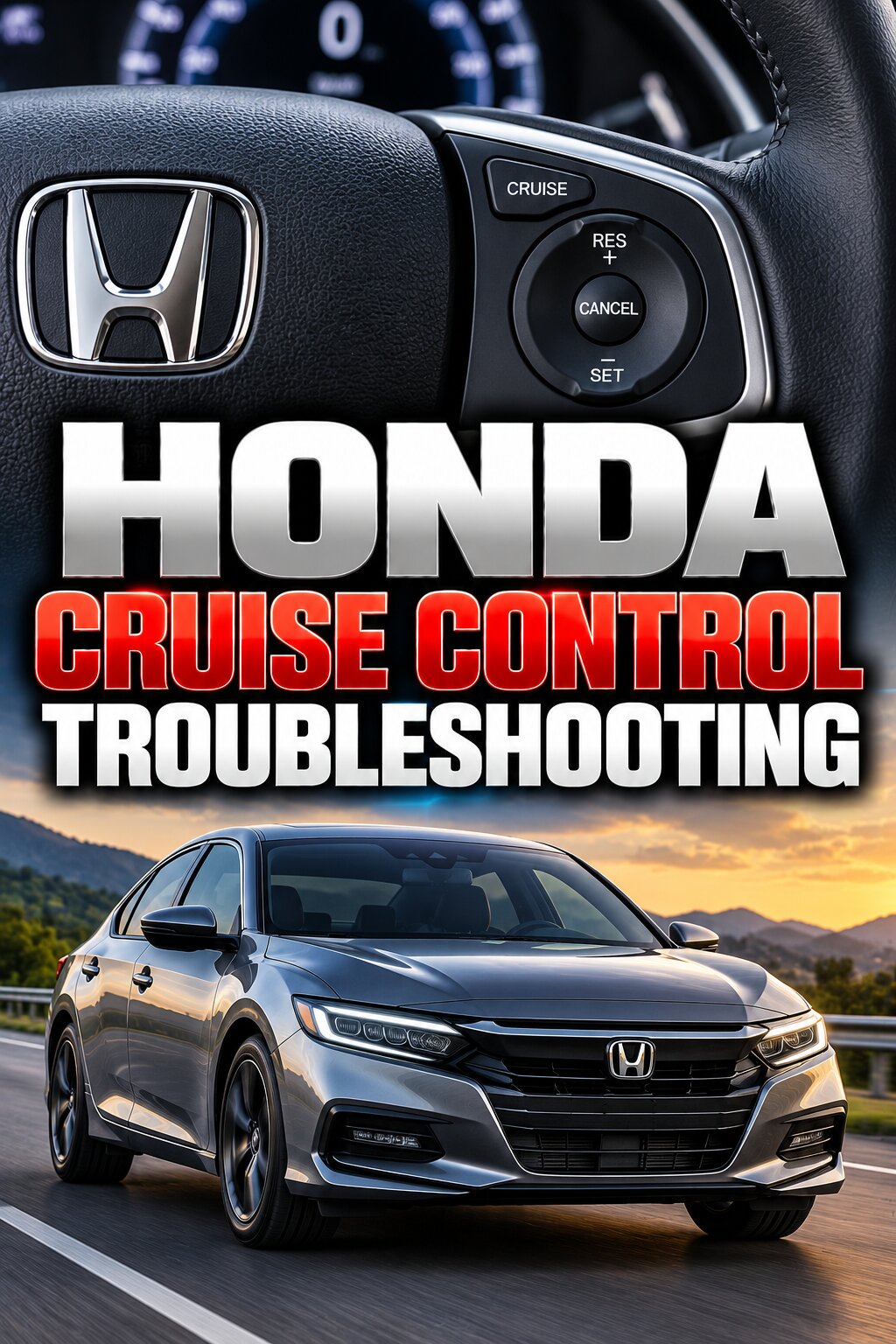
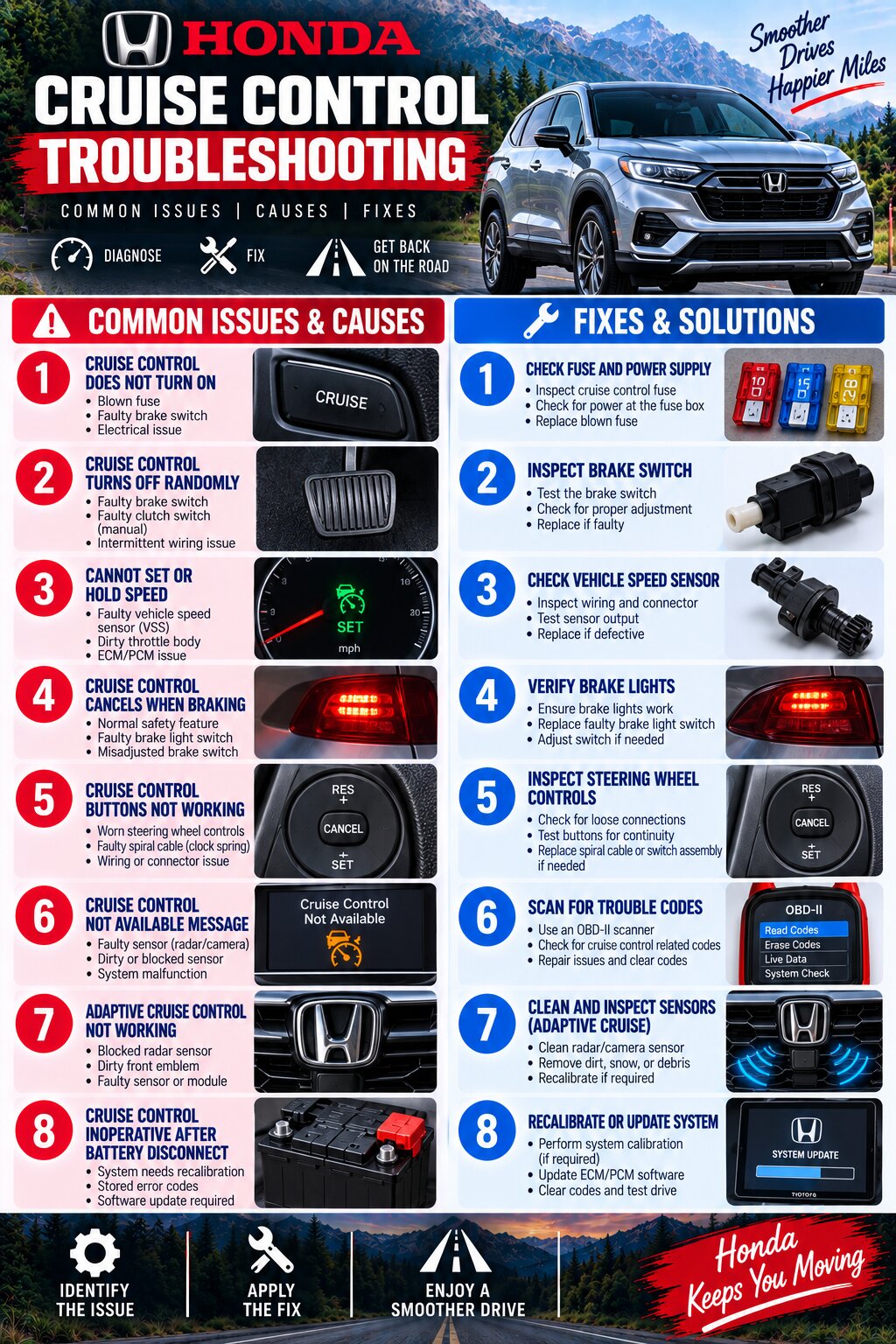
Honda cruise control systems are generally reliable. However, when the system suddenly stops working, many drivers become frustrated and worry about expensive repairs. The good news is that most cruise control problems stem from simple issues such as faulty brake switches, blown fuses, sensor failures, or dirty adaptive cruise control sensors.
Whether you drive a Honda Civic, Accord, CR-V, Pilot, Odyssey, or Ridgeline, the troubleshooting process follows a similar pattern. By understanding the symptoms and identifying the root cause, you can often fix the problem yourself or at least avoid unnecessary repair costs.
This guide explains the most common Honda cruise control problems, their causes, troubleshooting steps, repair options, and when professional diagnosis becomes necessary.
What Does Cruise Control Do?
Cruise control maintains a selected speed without keeping your foot on the accelerator pedal.
Traditional Honda cruise control systems use switches, sensors, actuators, and control modules to maintain vehicle speed. Meanwhile, newer Honda models equipped with Adaptive Cruise Control (ACC) use radar and cameras to maintain both speed and distance from vehicles ahead.
When any critical component stops communicating correctly, Honda’s safety programming disables cruise control.
Quick Diagnostic Guide by Symptom
| Symptom | Most Likely Cause |
|---|---|
| Cruise won’t turn on | Fuse, brake switch, wiring |
| Cruise turns on but won’t set | Brake switch, speed sensor |
| Cruise cancels randomly | Brake pedal stopper, sensor fault |
| ACC unavailable message | Dirty radar or camera |
| Cruise buttons don’t work | Clock spring or steering wheel switch |
| Cruise speed fluctuates | Speed sensor or throttle issue |
| ACC warning light on | Radar obstruction or calibration problem |
| Cruise and horn stop working together | Clock spring failure |
Models Most Affected by Specific Problems
| Problem | Models Commonly Affected |
|---|---|
| Broken brake pedal stopper | Accord, Civic, CR-V (older models) |
| Clock spring failure | Pilot, Odyssey, Accord |
| Radar sensor obstruction | Accord, Civic, CR-V, Passport, Pilot, Ridgeline |
| Windshield camera blockage | Civic, HR-V, Accord, CR-V |
| Steering wheel switch wear | Odyssey, Accord, Pilot |
| Speed sensor failure | CR-V, Fit, Civic |
| Vacuum actuator leaks | Older Accord, Prelude, Civic models |
Honda Cruise Control Problems and Fixes (Popular Models in the USA)
Honda Accord (2003–2025)
Common Problems
- Faulty brake pedal switch
- Cruise control switch failure
- Wheel speed sensor issues
- Adaptive Cruise Control (ACC) radar sensor blockage on newer models
- Clock spring failure behind steering wheel
Symptoms
- Cruise won’t turn on
- Cruise light comes on but won’t set
- ACC unavailable warning
- Random cruise disengagement
Fixes
- Replace brake switch
- Clean radar sensor and windshield camera
- Replace steering wheel switch or clock spring
- Scan and repair wheel speed sensor faults
Brake switch and sensor-related faults are among the most reported Accord cruise control issues. (Ryan’s Auto Care)
Honda Civic (2006–2025)
Common Problems
- Worn cruise control button assembly
- Broken brake pedal stopper
- Clock spring failure
- Faulty throttle actuator
- Vehicle speed sensor issues
Symptoms
- Cruise Main light only works when button is held
- Cruise won’t maintain speed
- Steering wheel buttons stop responding
Fixes
- Replace cruise control switch
- Install new brake pedal stopper
- Replace clock spring
- Diagnose throttle and speed sensors
The 2006-2015 Civic is particularly known for cruise switch wear and brake switch issues.
Honda CR-V (2007–2025)
Common Problems
- Steering wheel cruise switch failure
- Radar sensor obstruction (Honda Sensing models)
- Wheel speed sensor failure
- Brake switch faults
Symptoms
- ACC unavailable message
- Cruise turns off unexpectedly
- Cruise cannot be set
Fixes
- Clean front radar area
- Replace faulty switch assembly
- Repair wheel speed sensors
- Replace brake switch
Many CR-V cruise control complaints involve steering wheel switches and sensor-related failures.
Honda Pilot (2016–2025)
Common Problems
- Adaptive Cruise Control radar blockage
- Windshield camera issues
- Wheel speed sensor faults
- Brake pedal switch problems
Symptoms
- BRAKE warning appears
- ACC cancels automatically
- Cruise unavailable message
Fixes
- Clean radar and camera sensors
- Recalibrate radar after collision repairs
- Repair ABS or wheel speed sensor faults
- Replace brake switch
Honda notes that ACC can automatically cancel when sensors detect faults or operating conditions fall outside system limits.
Honda Odyssey (2011–2025)
Common Problems
- Brake light switch failure
- Cruise control module issues
- Steering wheel button wear
- Electrical wiring problems
Symptoms
- Cruise won’t engage
- Cruise drops out randomly
- Brake lights stay on
Fixes
- Replace brake switch
- Check fuses and wiring
- Test steering wheel controls
- Scan for stored fault codes
Honda Ridgeline (2017–2025)
Common Problems
- ACC radar sensor contamination
- Wheel speed sensor faults
- Clock spring failure
- Cruise switch wear
Symptoms
- Cruise unavailable warning
- Steering wheel controls malfunction
- Cruise will not set speed
Fixes
- Clean radar sensor
- Replace wheel speed sensor
- Install new clock spring
- Replace switch assembly
Most Common Honda Cruise Control Problems Overall
Across Accord, Civic, CR-V, Pilot, Odyssey, and Ridgeline models, these issues account for the majority of cruise control failures:
- Brake pedal switch failure
- Broken brake pedal stopper
- Cruise control switch wear
- Wheel speed sensor faults
- Radar or camera obstruction (Honda Sensing models)
- Clock spring failure
- Blown fuse
- Throttle actuator issues
- Wiring problems
- Cruise control module failure
Quick Tip
If your Honda cruise control suddenly stops working, check the brake lights first. A faulty brake switch or missing pedal stopper is one of the simplest and most common fixes across Honda vehicles in the United States.
Common Honda Cruise Control Symptoms
Before troubleshooting, identify the exact symptom.
Cruise Control Will Not Turn On
Possible signs include:
- Cruise Main light stays off
- Cruise button does nothing
- System appears completely dead
Cruise Control Turns On But Won’t Set
Possible signs include:
- Main indicator illuminates
- SET button does nothing
- Speed never locks in
Cruise Control Engages Then Cancels
Possible signs include:
- System works briefly
- Cruise disengages randomly
- Warning messages appear
Adaptive Cruise Control Warning Message
Possible signs include:
- ACC unavailable message
- Radar blocked warning
- Cruise control disabled notice
Cruise Speed Fluctuates
Possible signs include:
- Vehicle speeds up unexpectedly
- Vehicle slows down without reason
- Inconsistent speed holding
Most Common Causes of Honda Cruise Control Problems
Faulty Brake Pedal Switch
The brake pedal switch is one of the most common cruise control failure points in Honda vehicles. When you press the brake pedal, the switch signals the cruise system to cancel operation.
If the switch fails, the system may think the brake pedal remains pressed all the time. As a result, cruise control will not engage.
Symptoms
- Cruise control will not set
- Brake lights behave abnormally
- Cruise indicator illuminates but won’t engage
Troubleshooting
- Check brake light operation.
- Verify lights turn off completely when the pedal is released.
- Inspect switch adjustment near the pedal assembly.
- Replace the switch if faulty.
Broken Brake Pedal Stopper
Many older Honda vehicles use a small plastic stopper on the brake pedal arm.
Over time, this stopper can crack and fall apart. Once it breaks, the switch no longer receives the correct signal, causing cruise control failure.
Symptoms
- Cruise suddenly stops working
- Small plastic pieces found on floor mat
- Brake lights remain on continuously
Troubleshooting
Inspect the brake pedal area for missing rubber or plastic stoppers.
Fortunately, replacement parts are inexpensive and easy to install.
Blown Cruise Control Fuse
A blown fuse can disable the entire cruise control system.
Fortunately, checking fuses takes only a few minutes.
Symptoms
- Cruise system completely inoperative
- Cruise indicator never illuminates
Troubleshooting
- Locate fuse box.
- Consult owner’s manual.
- Inspect cruise control-related fuses.
- Replace blown fuses with the correct rating.
Faulty Vehicle Speed Sensor (VSS)
Cruise control depends on accurate speed information.
If the Vehicle Speed Sensor fails, Honda’s computer may disable cruise operation for safety reasons.
Symptoms
- Cruise control won’t engage
- Speedometer behaves erratically
- Check Engine Light appears
Troubleshooting
- Scan for diagnostic trouble codes
- Monitor vehicle speed readings
- Inspect sensor wiring
Steering Wheel Switch Problems
Cruise control buttons on the steering wheel receive heavy use over the years.
Eventually, contacts wear out or internal circuits fail.
Symptoms
- SET button doesn’t respond
- RESUME button fails
- Certain buttons work while others do not
Troubleshooting
- Test each steering wheel button
- Check switch continuity
- Inspect button connectors
Clock Spring Failure
The clock spring transfers signals between the steering wheel and the vehicle’s electronics.
When it fails, cruise control buttons often stop working.
Symptoms
- Cruise buttons fail
- Horn stops working
- Steering wheel controls malfunction
- Airbag warning light appears
Troubleshooting
A professional diagnosis usually confirms clock spring failure.
Vacuum Leak (Older Honda Models)
Many older Hondas use vacuum-operated cruise control actuators.
Cracked vacuum hoses reduce the actuator’s ability to control throttle position.
Symptoms
- Cruise engages briefly
- Vehicle loses speed on hills
- Cruise disengages randomly
Troubleshooting
Inspect:
- Vacuum hoses
- Actuator diaphragm
- Vacuum connections
Replace damaged hoses immediately.
Throttle Actuator Problems
Modern Hondas use electronic throttle control systems.
If the throttle body or actuator malfunctions, cruise control may stop functioning.
Symptoms
- Cruise won’t maintain speed
- Poor throttle response
- Engine warning lights
Troubleshooting
- Scan for throttle-related codes
- Inspect throttle body
- Check accelerator position sensor
Wiring Issues
Electrical problems can affect any cruise control component.
Corrosion, damaged connectors, or broken wires often create intermittent failures.
Symptoms
- Cruise works occasionally
- Problem appears during bumps
- Random cancellation
Troubleshooting
Inspect:
- Wiring harnesses
- Connectors
- Ground connections
Wiggle-test suspect wiring while monitoring system behavior.
Cruise Control Module Failure
Although less common, the control module can fail.
Symptoms
- All other components test correctly
- Cruise remains inoperative
- No obvious electrical faults
Troubleshooting
Professional diagnostics may be necessary to confirm module failure.
Honda Adaptive Cruise Control (ACC) Troubleshooting
Newer Honda models use Adaptive Cruise Control through Honda Sensing.
Unlike traditional systems, ACC depends on radar sensors and cameras. Therefore, environmental conditions can affect operation.
Dirty Radar Sensor
The radar sensor sits behind the front grille or Honda emblem.
Dirt, snow, mud, and bugs can block signals.
Symptoms
- ACC unavailable message
- Cruise control disabled
- Distance control failure
Troubleshooting
- Clean front grille area
- Remove snow buildup
- Wash sensor surfaces carefully
Dirty Windshield Camera
Honda Sensing relies heavily on windshield-mounted cameras.
A dirty windshield can prevent proper operation.
Symptoms
- ACC warning messages
- Lane assist issues
- Intermittent cruise operation
Troubleshooting
Clean:
- Windshield exterior
- Camera area behind rearview mirror
Severe Weather Conditions
Heavy rain, fog, snow, and direct sunlight can temporarily disable ACC. Honda specifically notes that these conditions can interfere with sensor operation.
Symptoms
- Temporary cancellation
- Warning messages
- Cruise unavailable
Troubleshooting
Wait until weather improves and restart the system.
Radar Misalignment
After collisions or bumper repairs, radar sensors may become misaligned.
Symptoms
- Constant ACC warnings
- Inaccurate following distance
- Frequent cancellation
Troubleshooting
Professional calibration is usually required.
Step-by-Step Honda Cruise Control Troubleshooting Checklist
Follow this order for the quickest diagnosis.
Step 1: Verify Operating Conditions
Ensure:
- Speed exceeds minimum cruise speed
- Cruise main switch is ON
- Seatbelt is fastened
- No active warning lights
Step 2: Check Brake Lights
A faulty brake switch remains one of the leading causes of cruise control failure.
Confirm brake lights operate normally.
Step 3: Inspect Fuses
Check:
- Cruise control fuse
- ECU-related fuses
- ACC system fuses
Step 4: Scan for Diagnostic Codes
Use an OBD-II scanner.
Look for:
- Speed sensor codes
- Throttle codes
- ABS codes
- Radar system codes
Step 5: Inspect Sensors
For ACC-equipped vehicles:
- Clean radar sensor
- Clean camera lens
- Remove debris
Step 6: Test Steering Wheel Controls
Verify:
- ON button works
- SET button responds
- RESUME button functions
Step 7: Check Wiring
Inspect:
- Connectors
- Harnesses
- Grounds
Step 8: Seek Professional Diagnosis
If the problem persists, advanced testing may identify module, radar, or communication issues.
When Should You Worry?
Most Honda cruise control issues are minor. However, some symptoms deserve immediate attention.
Seek Immediate Diagnosis If:
- ABS warning light appears
- Brake lights malfunction
- Multiple driver assistance systems fail
- Airbag warning light illuminates
- Speedometer behaves erratically
These symptoms may indicate broader electrical or safety system issues.
Repair Costs
Repair costs vary depending on the cause.
| Problem | Typical Repair Cost |
|---|---|
| Fuse Replacement | Low |
| Brake Switch | Low |
| Pedal Stopper | Very Low |
| Speed Sensor | Moderate |
| Clock Spring | Moderate |
| Throttle Body | High |
| Cruise Module | High |
| Radar Calibration | Moderate to High |
Early diagnosis often prevents larger repair bills.
Preventing Future Cruise Control Problems
A few simple habits can extend system life.
Keep Sensors Clean
Regularly clean:
- Honda emblem area
- Front grille
- Windshield camera zone
Address Warning Lights Quickly
Ignoring warning lights often leads to additional problems.
Inspect Brake Lights Periodically
A quick monthly inspection helps identify switch issues early.
Protect Electrical Connections
Avoid pressure washing sensitive connectors directly.
Perform Routine Maintenance
Regular maintenance helps electronic systems operate correctly.
Final Thoughts
Honda cruise control systems are dependable, but they can develop problems over time. Fortunately, many issues involve simple components such as brake switches, fuses, pedal stoppers, or dirty sensors. In many cases, a few minutes of troubleshooting can reveal the cause.
If your Honda cruise control stops working, start with the basics. Check the brake lights, inspect the fuse, verify sensor cleanliness, and scan for trouble codes. By following a logical process, you can often avoid expensive repairs and restore cruise control functionality quickly.
FAQs
Why won’t my Honda cruise control turn on?
The most common causes include a blown fuse, faulty brake switch, or electrical issue in the cruise control circuit.
Why does my cruise control light come on but not set?
A brake switch problem, speed sensor fault, or throttle control issue often causes this symptom.
Can a bad brake light switch affect cruise control?
Yes. Honda cruise control systems rely on the brake switch to determine when to engage or cancel operation.
Does a Check Engine Light disable cruise control?
Yes. Many Honda models automatically disable cruise control when certain engine faults occur.
Why does Adaptive Cruise Control say unavailable?
Dirty sensors, bad weather, blocked cameras, or radar faults commonly trigger this warning.
Can low battery voltage affect cruise control?
Yes. Electrical systems may malfunction when battery voltage drops too low.
Why does cruise control cancel itself while driving?
Faulty sensors, wiring problems, brake switch issues, or ACC sensor interference can cause random cancellation.
Can I drive safely if cruise control stops working?
Yes. Cruise control is a convenience feature, not a requirement for normal vehicle operation.
How much does it cost to fix Honda cruise control?
Repairs range from inexpensive fuse replacements to more costly radar calibration or module replacement.
Can I troubleshoot Honda cruise control myself?
Yes. Many common causes such as fuses, brake switches, and dirty sensors are DIY-friendly.
Helpful Resources
Official Honda Owner Information:
Honda Owners Manual Center
Honda Forum Discussion:
Honda-Tech Cruise Control Troubleshooting Thread
Repair Community Resource:
RepairPal Honda Cruise Control Diagnosis Guide