Seeing the orange malfunction warning light illuminate on your Nissan Qashqai dashboard can be concerning, especially if the vehicle appears to be driving normally. Whether you own a petrol, diesel, mild-hybrid, or e-Power Qashqai, this warning light indicates that the vehicle’s onboard diagnostics system has detected a fault that requires attention.
In most cases, the orange malfunction warning light is Nissan’s version of the Check Engine Light (MIL – Malfunction Indicator Lamp). According to Nissan’s owner documentation, the light may indicate an engine control system malfunction, emissions-related problem, or engine misfire. Some faults are minor, while others can reduce engine power or potentially damage the engine if ignored.
This guide explains what the orange warning light means, the most common causes, diagnostic procedures, repair costs, and what you should do when it appears.
What Is the Nissan Qashqai Orange Malfunction Warning Light?
The orange malfunction warning light, also called the MIL (Malfunction Indicator Lamp), is part of the vehicle’s engine management system.
When you switch the ignition on, the light briefly illuminates as a system check. If it stays on while driving, the engine control module has detected a fault within the engine, emissions system, fuel system, ignition system, or related electronics.
The warning can appear as:
- Engine-shaped warning light
- Malfunction Indicator Lamp (MIL)
- Engine Malfunction warning
- Service Engine Soon message
- Engine Malfunction Service Now message
The exact wording depends on the model year and trim level.
What Does a Steady Orange Warning Light Mean?
A continuously illuminated orange malfunction light generally indicates a fault that requires diagnosis but may not require immediate vehicle shutdown.
Nissan states that a steady orange MIL usually points to an engine control system malfunction. The vehicle may remain drivable, but inspection should be arranged as soon as possible.
Common Symptoms
You may notice:
- Reduced fuel economy
- Rough idling
- Slight loss of power
- Hesitation during acceleration
- Increased emissions
- Difficult starting
Sometimes the warning light appears without any noticeable symptoms.
What Does a Flashing Orange Warning Light Mean?
A flashing or blinking malfunction light is usually more serious.
According to Nissan documentation, a flashing MIL often indicates an engine misfire severe enough to damage the catalytic converter or emissions system. Drivers should reduce speed, avoid hard acceleration, and arrange immediate diagnosis.
Possible Symptoms
- Severe engine shaking
- Rough running
- Significant power loss
- Strong fuel smell
- Engine hesitation
Ignoring a flashing warning light can lead to expensive repairs.
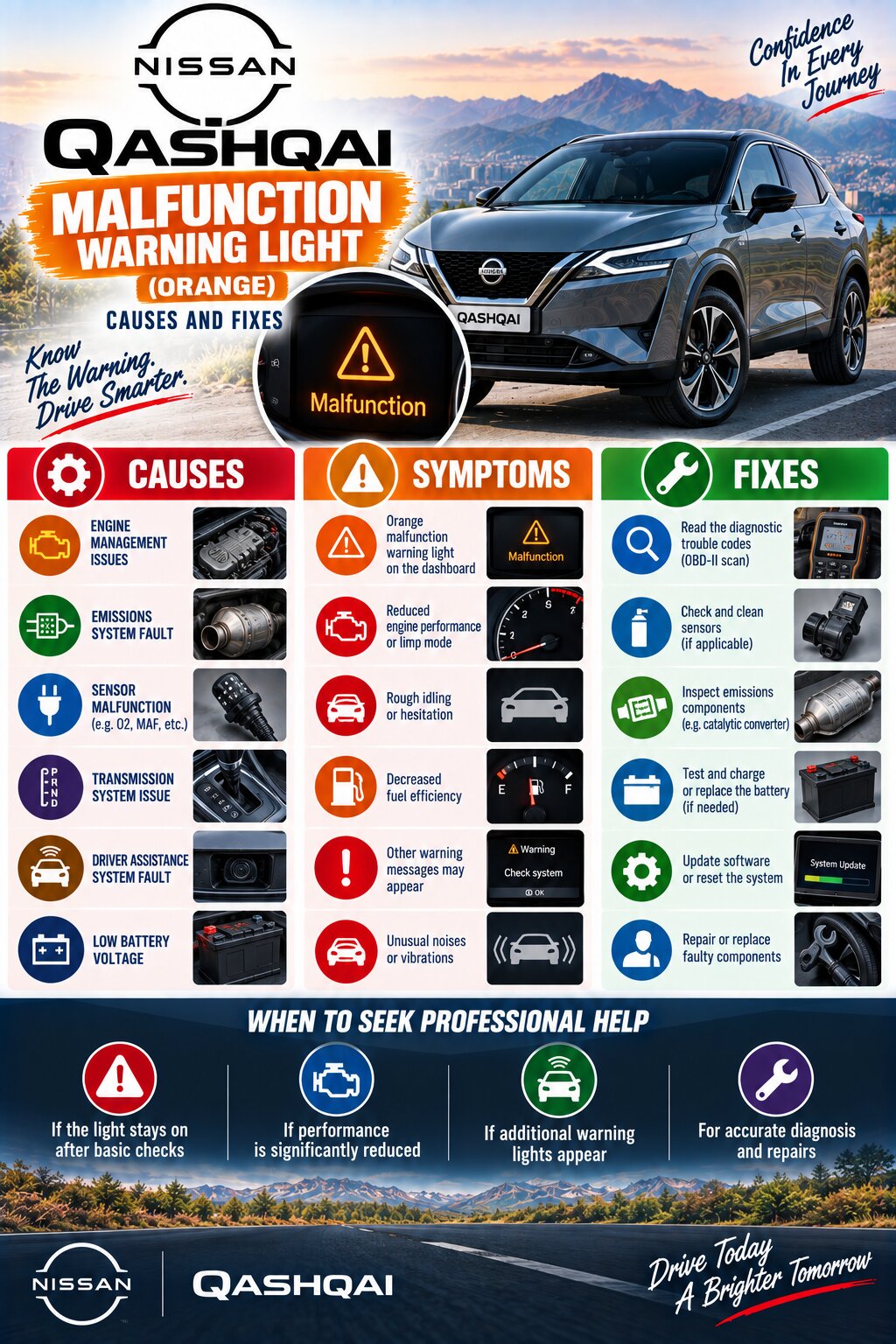
Common Causes of the Nissan Qashqai Orange Warning Light
Faulty Oxygen Sensor
Oxygen sensors monitor exhaust gases and help the engine control module adjust fuel delivery.
A failed oxygen sensor may cause:
- Check engine light
- Poor fuel economy
- Rough engine operation
- Increased emissions
This is one of the most common causes of engine warning lights.
Catalytic Converter Problems
The catalytic converter reduces harmful emissions.
A failing converter can trigger the orange warning light due to:
- Internal blockage
- Overheating
- Efficiency loss
- Damage from prolonged misfires
Symptoms may include poor acceleration and reduced fuel economy.
Ignition Coil Failure
Ignition coils provide voltage to the spark plugs.
When a coil fails, the engine may:
- Misfire
- Shake at idle
- Lose power
- Trigger a flashing malfunction light
Ignition coil issues are common on many modern petrol engines.
Spark Plug Problems
Worn spark plugs can cause:
- Engine misfires
- Hard starting
- Rough idle
- Reduced fuel economy
Regular maintenance helps prevent these issues.
Mass Air Flow Sensor Failure
The Mass Air Flow (MAF) sensor measures incoming air.
A faulty MAF sensor may result in:
- Hesitation
- Rough running
- Reduced power
- Warning light activation
Dirt and contamination frequently affect these sensors.
Fuel Injector Problems
Blocked or leaking injectors can disrupt combustion.
Potential symptoms include:
- Misfires
- Rough idle
- Hard starting
- Fuel consumption increases
Injector faults are more common on higher-mileage vehicles.
EGR Valve Problems
Diesel Qashqai models commonly experience Exhaust Gas Recirculation (EGR) issues.
Carbon buildup can cause:
- Poor performance
- Rough running
- Reduced fuel economy
- Warning lights
Frequent short trips often accelerate carbon accumulation.
Diesel Particulate Filter (DPF) Issues
Diesel-powered Qashqai models may trigger engine warnings when the DPF becomes clogged.
Common causes include:
- Frequent short journeys
- Interrupted regeneration cycles
- Excessive soot buildup
Symptoms often include reduced power and increased fuel consumption.
Turbocharger Faults
Turbocharged engines may illuminate the warning light if:
- Boost pressure is incorrect
- Turbo actuators fail
- Vacuum leaks occur
- Intercooler hoses split
These issues often produce noticeable performance loss.
EVAP System Leaks
The Evaporative Emissions Control System prevents fuel vapors from escaping.
Common faults include:
- Loose fuel cap
- Damaged hoses
- Purge valve failure
These issues often trigger warning lights without affecting drivability.
Nissan Qashqai e-Power Warning Light Causes
The e-Power model introduces additional components.
Possible causes include:
Hybrid System Faults
Hybrid control system issues may trigger orange warning indicators. Nissan notes that hybrid warning lights can indicate faults within the hybrid control system or high-voltage components.
Battery Management Issues
Faults involving:
- Battery cooling
- Voltage monitoring
- Battery communication
can generate warning messages.
Inverter Problems
The inverter converts battery power for propulsion.
Faults may result in:
- Reduced performance
- Warning lights
- Limited driving modes
Nissan Qashqai Warning Messages Explained
Engine Malfunction Service Now
This message indicates that a fault has been detected and should be inspected promptly.
Nissan advises having the vehicle checked by a qualified workshop as soon as possible.
Engine Malfunction Power Reduced Service Now
This message is more serious.
According to Nissan, the engine should be stopped and the vehicle inspected because a significant engine malfunction has been detected. Some versions of the owner’s manual recommend towing the vehicle to a repair facility.
Common OBD-II Trouble Codes
| Code | Description |
|---|---|
| P0300 | Random Misfire |
| P0301-P0304 | Cylinder Misfire |
| P0171 | Lean Fuel Mixture |
| P0101 | Mass Air Flow Sensor Fault |
| P0420 | Catalytic Converter Efficiency |
| P0401 | EGR Flow Insufficient |
| P2458 | DPF Regeneration Issue |
| P0299 | Turbo Underboost |
Reading these codes greatly speeds diagnosis.
How to Diagnose the Problem
Step 1: Scan for Fault Codes
Use an OBD-II scanner to retrieve stored codes.
Modern scan tools can often identify the affected system within minutes.
Step 2: Check Fuel Cap
A loose or damaged fuel cap can trigger emissions-related faults.
Ensure the cap is tightened properly.
Step 3: Inspect Air Intake Components
Look for:
- Loose hoses
- Cracked intake tubes
- Dirty air filters
- Damaged MAF sensor connectors
Step 4: Examine Ignition Components
Inspect:
- Spark plugs
- Ignition coils
- Wiring harnesses
These components commonly cause misfire-related warnings.
Step 5: Evaluate Fuel System Operation
Fuel pressure and injector performance may require professional testing.
Can You Continue Driving?
Usually Safe
If:
- Light is steady
- Vehicle drives normally
- No unusual noises occur
short-term driving may be possible while arranging repairs.
Stop Driving Immediately
If you experience:
- Flashing warning light
- Severe misfire
- Engine overheating
- Major power loss
- Engine Malfunction Power Reduced message
the vehicle should be inspected immediately.
Repair Costs
| Repair | Estimated Cost |
|---|---|
| Fuel Cap Replacement | $15-$60 |
| Oxygen Sensor | $150-$400 |
| Spark Plugs | $100-$350 |
| Ignition Coils | $150-$800 |
| MAF Sensor | $200-$500 |
| EGR Valve | $250-$900 |
| DPF Cleaning | $300-$1,200 |
| Catalytic Converter | $800-$3,000 |
| Turbocharger Repair | $1,000-$4,000 |
Actual costs vary by region and model year.
Preventing Future Warning Lights
Follow Maintenance Schedules
Regular servicing helps prevent many common faults.
Use Quality Fuel
Poor-quality fuel can contribute to injector and combustion issues.
Avoid Excessive Short Trips
Short journeys can accelerate:
- DPF clogging
- Carbon buildup
- EGR contamination
Replace Spark Plugs on Schedule
Fresh plugs reduce the risk of misfires.
Address Small Problems Early
Ignoring rough running or minor warning symptoms often leads to more expensive repairs later.
Frequently Asked Questions
What does the orange malfunction warning light mean on a Nissan Qashqai?
It generally indicates an engine control system, emissions, or engine management fault detected by the vehicle’s computer.
Can I drive with the orange warning light on?
If the light is steady and the vehicle drives normally, short-term driving may be possible. A flashing light requires immediate attention.
What causes the light to flash?
A flashing MIL often indicates an engine misfire that could damage the catalytic converter.
Will the light reset itself?
Some temporary faults may clear automatically after several drive cycles, but most persistent faults require diagnosis and repair.
How much does it cost to fix?
Repairs can range from a simple fuel cap replacement to major catalytic converter or turbocharger repairs.
Conclusion
The Nissan Qashqai orange malfunction warning light should never be ignored. While some causes are relatively minor, others can lead to reduced performance, increased emissions, poor fuel economy, or expensive engine damage. Common culprits include oxygen sensors, ignition coils, spark plugs, EGR valves, DPF issues, turbocharger faults, and emissions-system problems.
Prompt diagnosis using an OBD-II scanner can help identify the root cause and prevent more costly repairs. Whether you drive a petrol, diesel, mild-hybrid, or e-Power Qashqai, addressing the warning light quickly is the best way to maintain reliability and performance.
References
- Nissan Qashqai Owner’s Manual – Malfunction Warning Light (MIL)
https://www.nissan.co.uk/owners/car-repair/ - Nissan Qashqai Forums
https://www.qashqaiforums.co.uk/viewtopic.php?t=5297