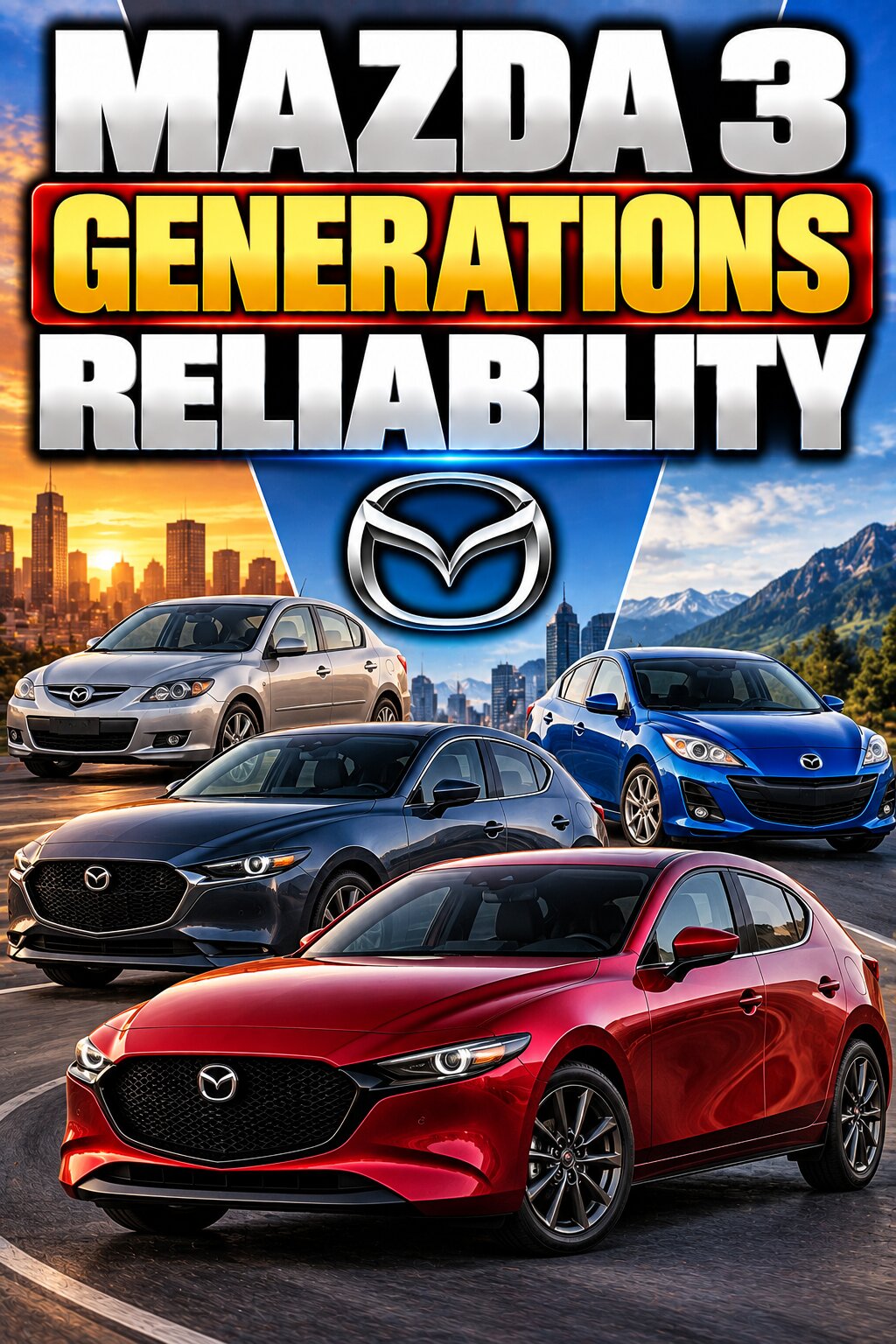
The Mazda 3 has been one of the most successful compact cars since its introduction for the 2004 model year. Known for combining sporty handling, attractive styling, and competitive pricing, the Mazda 3 has become a favorite among drivers who want something more engaging than a typical economy car.
Over four generations, the Mazda 3 has evolved from a simple compact sedan and hatchback into a near-premium vehicle that competes with much more expensive models. However, not all Mazda 3 generations are equally reliable. Some years are known for rust, transmission issues, clutch problems, and electrical faults, while others have developed a reputation for exceptional durability.
This guide examines every Mazda 3 generation, common problems, reliability ratings, ownership costs, and the best model years to buy.
Mazda 3 Generations Overview
| Generation | Years |
|---|---|
| First Generation (BK) | 2004-2009 |
| Second Generation (BL) | 2010-2013 |
| Third Generation (BM/BN) | 2014-2018 |
| Fourth Generation (BP) | 2019-Present |
The Mazda 3 has remained one of Mazda’s best-selling vehicles throughout its production history and is generally considered one of the more reliable compact cars on the market. However, reliability varies significantly between generations.
First Generation Mazda 3 (BK) Reliability
Model Years
- 2004
- 2005
- 2006
- 2007
- 2008
- 2009
Overview
The first-generation Mazda 3 replaced the Mazda Protegé and immediately became a success thanks to its sporty handling and attractive styling.
Engine options included:
- 2.0L MZR four-cylinder
- 2.3L MZR four-cylinder
- Mazdaspeed3 turbocharged variant
The BK generation remains popular today because of its affordable purchase price and engaging driving dynamics.
Reliability Rating
Overall reliability is good, especially considering many examples are now over 15 years old. However, age-related issues are becoming increasingly common.
Several reliability studies place the first generation ahead of the second generation but behind the newer Skyactiv-powered models.
Common Problems
Rust and Corrosion
The biggest issue affecting first-generation Mazda 3 models is rust.
Common rust locations include:
- Rear wheel arches
- Rocker panels
- Rear subframe
- Suspension mounting points
- Underbody components
Vehicles operated in snowy climates often experience severe corrosion.
Automatic Transmission Issues
Some early automatic-equipped models experienced:
- Harsh shifting
- Delayed engagement
- Transmission wear
While not widespread enough to affect every vehicle, transmission condition should be carefully evaluated on high-mileage examples.
Motor Mount Failure
Motor mounts frequently wear out on aging BK models.
Symptoms include:
- Excessive vibration
- Engine movement
- Clunking noises
This is usually a straightforward repair.
Best Years
The 2007-2009 models tend to be the most refined examples of the first generation.
Years to Approach Carefully
- 2004
- 2005
These early years accumulated the highest number of owner complaints.
Second Generation Mazda 3 (BL) Reliability
Model Years
- 2010
- 2011
- 2012
- 2013
Overview
Mazda redesigned the Mazda 3 for 2010 with updated styling, improved comfort, and new technology.
This generation also introduced early Skyactiv technology toward the end of production.
Despite its improvements, the BL generation is widely regarded as the least reliable Mazda 3 generation.
Reliability Rating
Several reliability rankings place the second generation at or near the bottom among Mazda 3 generations. Complaint data shows significantly more reported problems compared with other generations.
Common Problems
Clutch Failures
Manual transmission models developed a reputation for premature clutch wear.
Symptoms include:
- Slipping clutch
- Difficult shifting
- Clutch chatter
- Premature clutch replacement
Numerous owner complaints and legal actions were associated with clutch concerns.
Transmission Control Module Problems
Automatic models sometimes experienced issues involving the Transmission Control Module (TCM).
Potential symptoms include:
- Transmission shifting issues
- Warning lights
- Drivability concerns
These problems are most commonly reported on early models.
Dashboard Melting
Some owners reported dashboard deterioration in hot climates.
Symptoms included:
- Sticky surfaces
- Glare issues
- Material degradation
This became one of the generation’s most frequently discussed complaints.
Valve Stem Corrosion
Certain vehicles experienced TPMS-related valve stem corrosion problems that could trigger warning lights or air loss concerns.
Best Years
- 2012
- 2013
The final years benefited from incremental improvements and newer Skyactiv technology.
Worst Year
Many reliability studies identify the 2010 model year as the most problematic.
Third Generation Mazda 3 (BM/BN) Reliability
Model Years
- 2014
- 2015
- 2016
- 2017
- 2018
Overview
The third-generation Mazda 3 represented a major leap forward.
Mazda introduced:
- Kodo design language
- Skyactiv engines
- Improved fuel economy
- Better interiors
- Lower vehicle weight
Many enthusiasts consider this generation the sweet spot between affordability and modern technology.
Reliability Rating
Reliability improved considerably compared with the second generation.
Most problems involve early production vehicles rather than the generation as a whole.
Common Problems
Infotainment System Issues
Some owners report:
- Screen freezing
- Random reboots
- Backup camera problems
- Connectivity issues
Most concerns involve early model years.
Brake System Concerns
Several recalls and service campaigns addressed braking system issues.
Potential symptoms include:
- Parking brake malfunctions
- Premature brake wear
- Brake actuator corrosion
Affected vehicles were subject to manufacturer remedies.
Air Conditioning Problems
Some owners reported:
- Weak cooling
- Blower issues
- HVAC system faults
These issues were relatively uncommon compared with previous-generation concerns.
Best Years
Many used-car experts recommend:
- 2017
- 2018
These vehicles benefited from several years of refinement and tend to show fewer complaints.
Years to Watch
- 2014
- 2015
First-year redesigns often experience more issues than later production years.
Fourth Generation Mazda 3 (BP) Reliability
Model Years
- 2019
- 2020
- 2021
- 2022
- 2023
- 2024
- 2025
- 2026
Overview
The fourth-generation Mazda 3 elevated the model into near-luxury territory.
Major upgrades included:
- Premium interior materials
- Advanced driver-assistance features
- Improved refinement
- Available AWD
- Turbocharged engine option
This generation competes not only with mainstream compact cars but also with entry-level luxury vehicles.
Reliability Rating
Most available reliability data indicates the fourth generation is currently the most reliable Mazda 3 generation overall. Complaint rates remain relatively low compared with earlier models.
Common Problems
Oil Consumption (Turbo Models)
Some turbocharged models experienced elevated oil consumption.
Potential symptoms include:
- Oil level warnings
- Frequent top-offs
- Service bulletins
Not every turbocharged vehicle is affected.
Infotainment Glitches
Occasional reports include:
- Connectivity problems
- Software bugs
- Display issues
Most problems are software-related rather than mechanical.
Minor Electronic Issues
As with many modern vehicles, increased electronic complexity occasionally results in:
- Sensor warnings
- Software updates
- Infotainment concerns
However, these issues are generally minor.
Best Years
Current reliability discussions frequently highlight:
- 2022
- 2023
- 2024
as particularly strong performers.
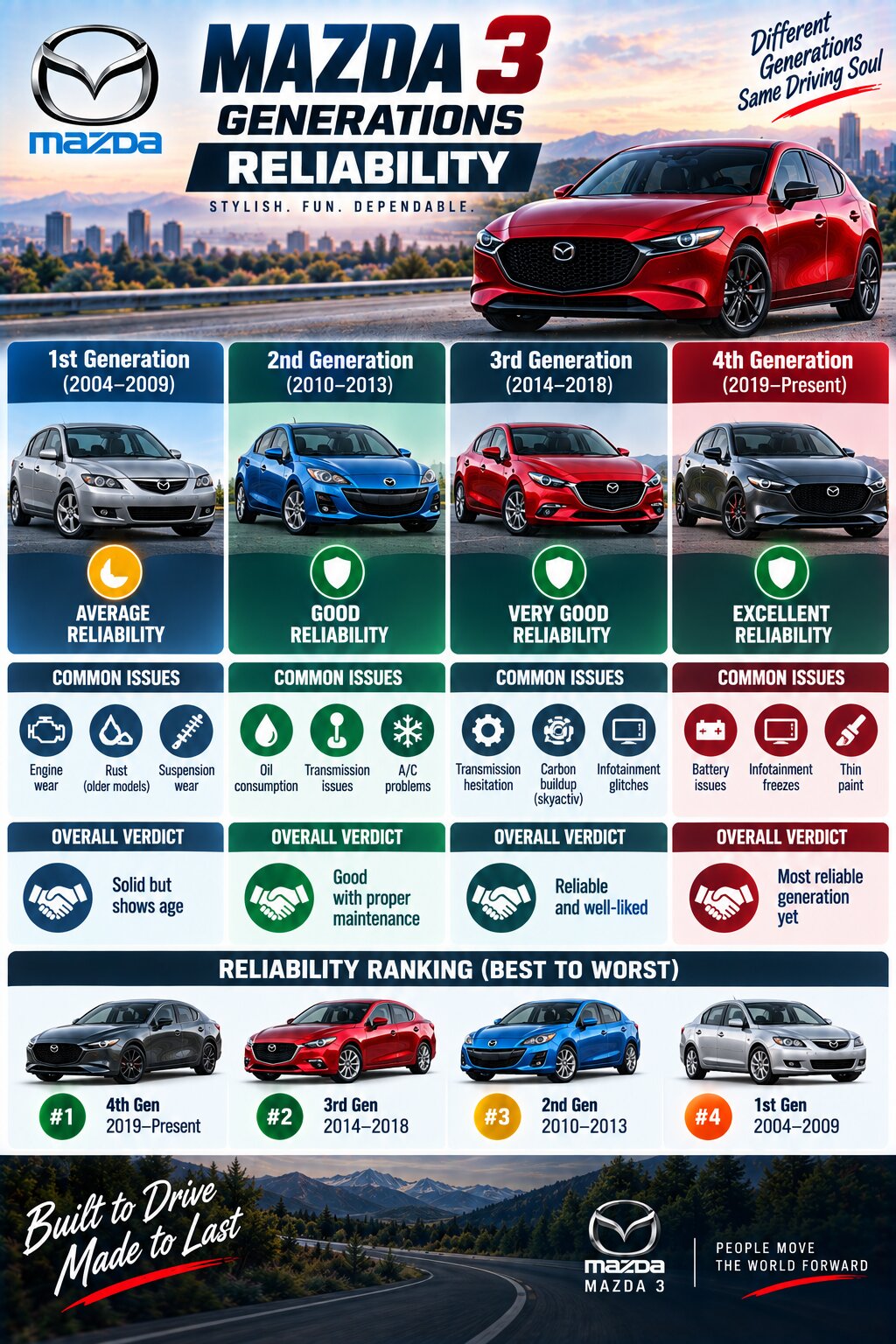
Reliability Ranking: Best to Worst
1. Fourth Generation (2019-Present)
Strengths:
- Lowest complaint rates
- Premium build quality
- Improved engineering
- Excellent safety technology
2. Third Generation (2014-2018)
Strengths:
- Proven Skyactiv engines
- Excellent fuel economy
- Strong reliability record
- Affordable ownership
3. First Generation (2004-2009)
Strengths:
- Simple design
- Inexpensive repairs
- Strong engines
Weaknesses:
- Rust
- Age-related failures
4. Second Generation (2010-2013)
Weaknesses:
- Clutch issues
- Interior quality concerns
- Higher complaint volume
- More recalls
Several complaint databases and reliability rankings identify the second generation as the least reliable Mazda 3 generation overall.
Engines With the Best Reliability
2.0L Skyactiv-G
Widely considered one of Mazda’s most reliable engines.
Advantages:
- Excellent fuel economy
- Simple design
- Low maintenance costs
2.5L Skyactiv-G
Benefits include:
- Strong performance
- Proven durability
- Excellent reliability history
2.5L Turbo
Offers significantly more performance but introduces additional complexity.
Most owners report good reliability, though some oil-consumption concerns have been documented.
Should You Buy a Used Mazda 3?
Best Budget Choice
2017-2018 Mazda 3
Reasons:
- Proven reliability
- Modern technology
- Affordable prices
- Excellent fuel economy
Best Overall Choice
2022+ Mazda 3
Reasons:
- Most refined generation
- Excellent safety features
- Premium interior
- Strong reliability reputation
Best Value Choice
2018 Mazda 3
Many enthusiasts consider the 2018 model year one of the best values in the entire Mazda 3 lineup because it combines mature third-generation engineering with relatively modern technology.
Frequently Asked Questions
Which Mazda 3 generation is the most reliable?
Most available reliability data points to the fourth generation (2019-present) as the most reliable Mazda 3 generation overall.
Which Mazda 3 years should I avoid?
Many buyers approach 2010 models cautiously due to higher complaint volumes involving clutches, interior issues, and transmission concerns.
Is the Mazda 3 reliable compared with competitors?
Yes. The Mazda 3 generally maintains a strong reputation for reliability while offering more engaging driving dynamics than many compact-car rivals.
Is the Mazda 3 expensive to maintain?
No. Maintenance costs are typically moderate and comparable to other Japanese compact cars.
How many miles can a Mazda 3 last?
With proper maintenance, many Mazda 3 models exceed 200,000 miles. Numerous owners report significantly higher mileages on well-maintained vehicles.
Conclusion
The Mazda 3 has evolved dramatically since its debut in 2004, and its reliability has generally improved with each generation. While the first generation remains popular despite rust concerns and the second generation struggles with a higher rate of reported problems, the third and fourth generations represent some of the best compact cars available on the used market.
For buyers seeking maximum reliability, the 2017-2018 third-generation models and 2022-plus fourth-generation vehicles stand out as the strongest choices. Regardless of generation, a well-maintained Mazda 3 continues to offer an excellent combination of reliability, driving enjoyment, efficiency, and long-term value.