Liqui Moly Cera Tec is one of the most popular engine oil additives on the market. Designed to reduce friction and wear using micro-ceramic particles and chemical friction modifiers, it has developed a strong following among automotive enthusiasts and professional mechanics. According to Liqui Moly, Cera Tec can reduce engine wear, improve smoothness, and provide protection for up to 50,000 km under certain conditions.
Despite its popularity, some vehicle owners report concerns after using the additive. Complaints range from reduced effectiveness after oil changes to compatibility concerns, sludge-related issues in neglected engines, improper application, and unrealistic expectations regarding performance gains. While many of these problems are not directly caused by Cera Tec itself, understanding them can help you avoid costly mistakes.
This guide explains the most common Liqui Moly Cera Tec problems, their causes, and practical fixes.
What Is Liqui Moly Cera Tec?
Cera Tec is a friction-reducing oil additive that combines micro-ceramic particles with chemical anti-wear agents. The product is designed to reduce metal-to-metal contact, improve lubrication, and minimize wear in gasoline and diesel engines. It is compatible with most conventional and synthetic engine oils and can also be used in certain manual transmissions and compressors.
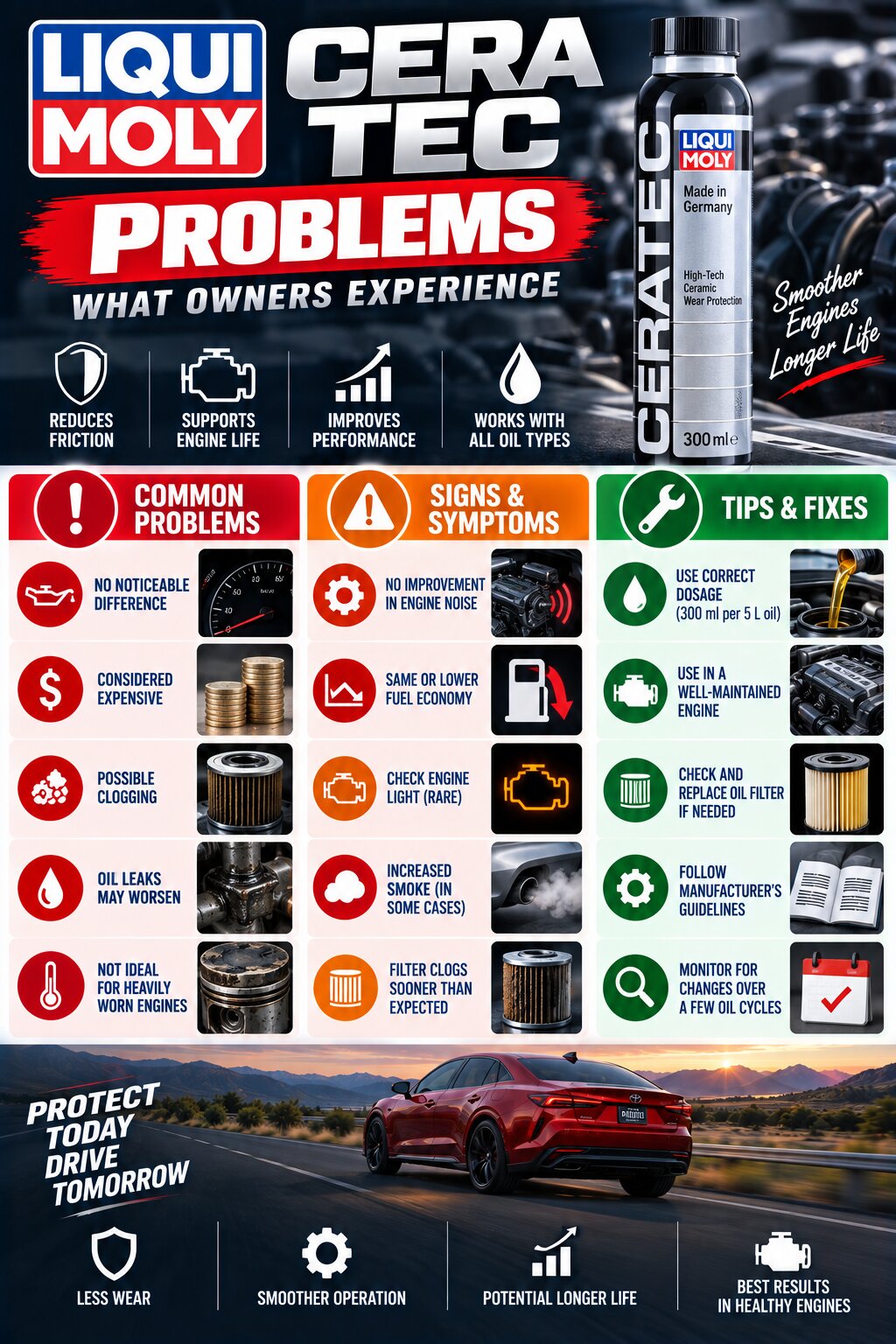
According to Liqui Moly, one 300 ml can treats approximately 3–5 liters of oil and is intended for most four-stroke engines. (Liqui Moly)
Common Liqui Moly Cera Tec Problems
Reduced Effect After an Oil Change
One of the most common complaints involves the additive seemingly losing its effectiveness after an oil change.
Drivers often report:
- Engine becomes noisier again
- Smoothness decreases
- Fuel economy improvements disappear
- Reduced perceived performance benefits
This occurs because much of the additive is removed during the oil change process. While Liqui Moly states the protective effect can last for extended periods, users frequently observe that the benefits diminish once fresh oil replaces the treated oil. (Liqui Moly Forum)
Fix
- Reapply Cera Tec according to manufacturer recommendations.
- Add it shortly after an oil change for maximum effectiveness.
- Do not expect permanent improvements from a single treatment.
Sludge-Related Problems in Dirty Engines
Cera Tec itself does not create sludge. However, heavily neglected engines may already contain sludge, varnish, and carbon deposits.
In some user reports, adding advanced additives to severely neglected engines appeared to disturb existing deposits, potentially contributing to oil flow restrictions in already compromised engines. (Team-BHP.com)
Symptoms
- Oil pressure warning light
- Reduced oil flow
- Engine noise
- Hydraulic lifter ticking
- Severe engine damage in extreme cases
Fix
Before using Cera Tec in a high-mileage or poorly maintained vehicle:
- Inspect engine maintenance history.
- Consider an engine cleaning service if sludge is suspected.
- Avoid adding performance additives to engines with known lubrication issues.
Incorrect Dosage Problems
Some users mistakenly assume that adding more Cera Tec will provide additional protection.
Overdosing can potentially alter oil chemistry and reduce the effectiveness of the oil package.
Liqui Moly recommends approximately one 300 ml can for 3–5 liters of engine oil.
Symptoms
- Unnecessary additive concentration
- Potential oil performance changes
- Increased operating costs
Fix
Always follow the manufacturer’s dosage recommendations.
More additive does not automatically mean better protection.
Using Cera Tec in Incompatible Applications
One of the biggest user mistakes involves using Cera Tec in systems for which it was not designed.
Liqui Moly specifically states that Cera Tec is not suitable for:
- Wet clutch systems
- DSG transmissions
- DCT transmissions
- Certain automatic transmissions
Improper use may affect clutch performance or transmission operation.
Symptoms
- Clutch slippage
- Shift quality changes
- Transmission concerns
Fix
Always verify compatibility before use.
Consult:
- Owner’s manual
- Manufacturer recommendations
- Liqui Moly application guides
Unrealistic Performance Expectations
Many buyers expect dramatic horsepower gains after adding Cera Tec.
In reality, Cera Tec is designed primarily as a wear-reduction additive rather than a performance enhancer.
While some users report:
- Quieter operation
- Smoother idle
- Slight fuel economy improvements
Most drivers will not experience significant power increases.
Fix
Use Cera Tec for:
- Wear reduction
- Friction reduction
- Engine protection
Do not purchase it expecting major performance upgrades.
Concerns About Warranty Coverage
Some vehicle owners worry that aftermarket oil additives could affect warranty claims.
Manufacturers may question the use of non-approved additives during warranty investigations.
Although Cera Tec is designed for compatibility with most modern oils, warranty decisions ultimately remain with the vehicle manufacturer. (Glenn Said)
Fix
For vehicles under factory warranty:
- Review warranty documents.
- Confirm compatibility with dealership service departments.
- Use only products approved by the manufacturer when necessary.
Sediment and Mixing Issues
Because Cera Tec contains ceramic particles, improper storage may allow particles to settle.
If the product is not properly shaken before use, distribution may become uneven.
Liqui Moly specifically recommends shaking the container thoroughly before adding it to the engine oil.
Symptoms
- Uneven additive distribution
- Reduced effectiveness
- Inconsistent results
Fix
- Shake the bottle thoroughly.
- Pour into warm or freshly changed oil.
- Drive normally to promote proper mixing.
High-Mileage Engine Limitations
Many owners use Cera Tec hoping it will fix existing engine wear.
While it may reduce friction, it cannot repair:
- Worn piston rings
- Damaged bearings
- Excessive oil consumption
- Compression loss
- Mechanical failures
Some users become disappointed when major problems remain unchanged.
Fix
Understand the product’s purpose.
Cera Tec is designed to:
- Reduce wear
- Improve lubrication
- Protect components
It is not an engine rebuild in a bottle.
Increased Oil Consumption Concerns
Some drivers report increased oil consumption after switching oils and adding additives.
In most cases, the additive itself is unlikely to be the root cause.
Oil consumption is usually linked to:
- Worn valve seals
- Piston ring wear
- Turbocharger wear
- Existing engine age
Liqui Moly representatives have indicated that Cera Tec does not damage engine seals.
Fix
Investigate:
- Oil leaks
- Compression issues
- Turbocharger condition
- PCV system operation
Do not automatically blame the additive.
Common User Mistakes
Adding to Extremely Old Oil
Some owners add Cera Tec near the end of an oil change interval.
This limits effectiveness because contaminated oil may already contain:
- Fuel dilution
- Oxidation products
- Wear metals
Fix
Add Cera Tec:
- During oil changes
- Shortly after fresh oil installation
This maximizes protection.
Mixing Multiple Additives
Using numerous additives simultaneously can create unpredictable results.
Examples include combining:
- Friction modifiers
- Viscosity improvers
- Stop-leak products
- Fuel additives
Fix
Use only necessary additives.
Avoid creating an unknown chemical mixture in the crankcase.
Vehicles That May Benefit Most
Cera Tec often works best in:
Daily Drivers
Benefits may include:
- Smoother operation
- Reduced wear
- Improved engine refinement
Turbocharged Vehicles
Liqui Moly states the product is compatible with turbocharged engines and modern emissions equipment.
Long Highway Commuters
Drivers accumulating high mileage may appreciate the additional wear protection.
Older Well-Maintained Engines
Engines with solid maintenance histories may respond better than neglected engines.
Vehicles That May Not Benefit Significantly
Results may be less noticeable in:
- Brand-new engines
- Severely worn engines
- Poorly maintained engines
- Vehicles with mechanical damage
The additive cannot compensate for major mechanical failures.
Frequently Asked Questions
Can Liqui Moly Cera Tec damage an engine?
When used correctly and according to manufacturer instructions, Cera Tec is designed to be safe for most gasoline and diesel engines.
Does Cera Tec clog oil filters?
Liqui Moly states the ceramic particles are filter compatible and suitable for modern oil filtration systems.
Can I use Cera Tec with synthetic oil?
Yes. It is designed to work with most commercially available synthetic and conventional engine oils.
Does Cera Tec stop engine knocking?
It may reduce friction-related noise, but it will not repair mechanical knocking caused by worn bearings or internal engine damage.
Can I use Cera Tec in automatic transmissions?
No. Liqui Moly specifically advises against use in DSG, DCT, automatic transmissions, and wet-clutch systems.
How long does Cera Tec last?
Liqui Moly states protection can last up to 50,000 km under recommended conditions. Actual user experiences vary depending on oil change intervals and operating conditions.
Conclusion
Liqui Moly Cera Tec remains one of the most widely used anti-wear oil additives available. Most reported “problems” stem from incorrect usage, unrealistic expectations, neglected engine conditions, or compatibility mistakes rather than defects in the product itself.
Common concerns include reduced effectiveness after oil changes, use in dirty engines, incorrect dosage, transmission compatibility issues, and expectations of dramatic performance gains. When used correctly in a healthy engine and according to manufacturer guidelines, Cera Tec can provide additional wear protection and smoother engine operation. However, it should be viewed as a preventative maintenance product rather than a solution for existing mechanical problems.